
Research is one of the defining pillars of higher education. Through research, universities expand human knowledge, solve real-world problems and contribute to social, economic and technological progress. From scientific discoveries and medical breakthroughs to innovations in education, sustainability and public policy, research shapes how societies develop and respond to new challenges.
Yet the nature of research has changed. Many of today’s biggest issues, including climate change, public health, artificial intelligence, food security, digital transformation and sustainable development, are too complex for one researcher or one institution to address alone. Meaningful research is increasingly built through research collaboration, which brings together experts with different perspectives, disciplines and experiences.
For universities, collaboration is no longer an optional extra. It is an essential part of building a vibrant, globally connected research culture. This article explores the research collaboration opportunities available to member universities, the main types of partnership, how to get started, and how a professional network such as IACU can help.
Every university has its own strengths. Some are recognised for scientific research, others for social sciences, engineering, healthcare, education, business or technology. Each contributes valuable expertise, but when those strengths are combined, research becomes more dynamic and comprehensive.
Collaborative research allows scholars to:
For individual researchers, collaboration creates chances to exchange ideas, learn new methodologies and work with colleagues whose experience differs from their own. These interactions often lead to fresh insights, innovative research questions and stronger academic outcomes.
Research partnerships also help universities strengthen their academic profile. Institutions that take part in collaborative research join wider scholarly conversations and contribute to knowledge that reaches beyond their own region or discipline.
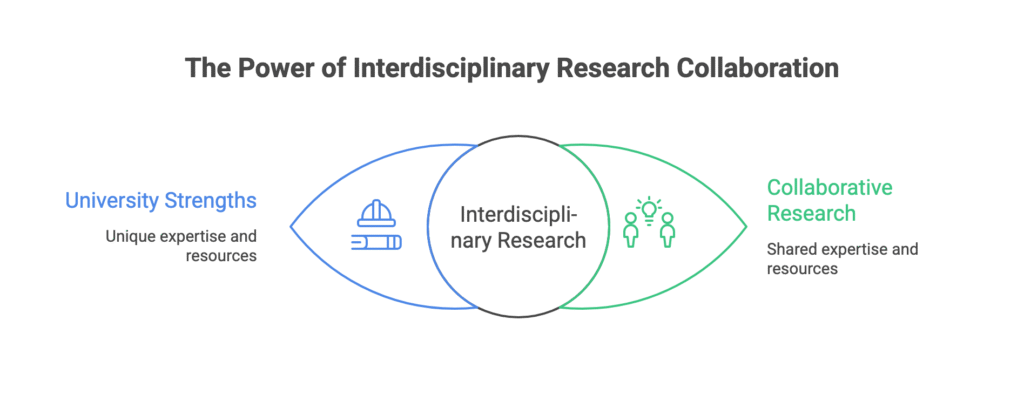
University research collaboration happens when two or more institutions, research groups or individual scholars work together toward a shared research goal. It can be formal or informal, short-term or long-term, small or large.
A collaboration might be a single co-authored paper, or it might be a multi-year programme involving several universities in different countries. What matters is the shared purpose and the mutual benefit: each partner brings something the others do not have, and each gains from the exchange.
Collaboration can also be organised in different ways:
Each model suits different goals, resources and stages of development, and many universities use all three over time.
Member universities can explore a wide range of partnership formats. The most common include the following.
Co-authored papers, book chapters and reports are often the first visible outcome of a partnership. They combine expertise, widen readership and give each author access to the other’s academic networks.
Projects that bring together researchers from different fields, such as engineering and public health, or education and data science, are well suited to complex, real-world problems. They also encourage new research questions that a single discipline might not ask.
Researchers from several institutions can submit joint proposals to funding bodies. A strong consortium shows breadth of expertise and often makes a proposal more competitive. Partnerships built early, before a call is announced, are usually the most successful.
Visiting fellowships, short research stays and staff exchanges allow scholars to learn from another institution’s environment, laboratories, datasets and methods. These visits often turn into lasting working relationships.
Co-hosting or co-organising academic events is a practical way to test a partnership, share findings and attract wider participation from the research community.
Co-supervision, joint doctoral seminars and mentoring schemes give early-career researchers broader networks and exposure to different research cultures. This benefits both the individuals and the institutions that support them.
Partners can pool expertise in research methods, share data where appropriate and ethical, and make better use of specialist equipment or facilities.
One of the greatest advantages of international research collaboration is the diversity it brings to academic inquiry.
Researchers in different countries often approach similar challenges from different cultural, economic or policy perspectives. These differences enrich discussion and lead to more balanced and comprehensive outcomes.
Studies in education, healthcare, sustainability or technology frequently benefit from comparing practices across regions. Understanding how institutions in different parts of the world respond to similar issues helps researchers identify patterns, evaluate alternative approaches and develop solutions with broader relevance.
Cross-border research also improves quality by encouraging peer learning and continuous academic dialogue. Researchers are exposed to unfamiliar methodologies, theoretical frameworks and institutional experiences. All of this contributes to more rigorous and innovative scholarship.
Successful research partnerships are built on more than shared academic interests. They rely on trust, open communication and long-term professional relationships.
Many collaborations begin with a simple conversation between researchers who discover common interests at an academic event or professional discussion. Early interactions like these often grow into:
Research networks therefore play an essential role in connecting researchers with potential collaborators. They create spaces where scholars can discuss emerging topics, exchange ideas and identify opportunities to work together across institutional and national boundaries.
For universities seeking to strengthen their research culture, taking part in these networks expands academic connections and keeps staff engaged with developments across disciplines.
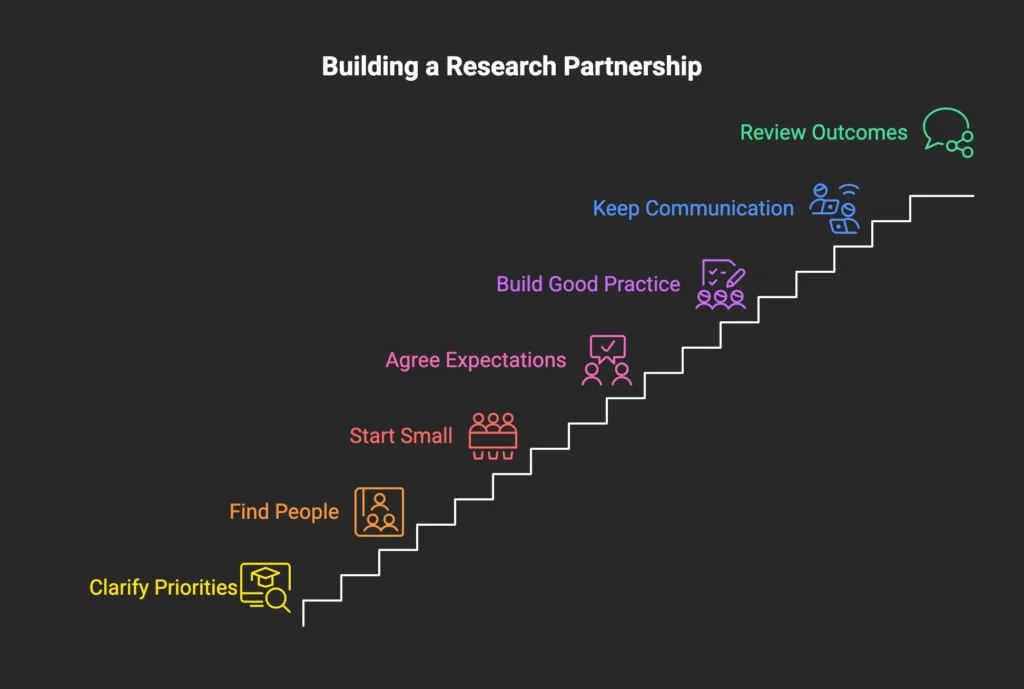
Building a partnership does not have to begin with a large project or a formal agreement. A simple, step-by-step approach works well.
Collaboration brings great benefits, but it also takes effort. Institutions commonly face challenges such as:
Most of these challenges can be reduced by building relationships first and formal structures second.
The International Association of Colleges & Universities (IACU) recognises that collaboration is one of the strongest drivers of academic innovation. As a global membership association, IACU brings together universities, colleges, vocational institutions, online education providers and research organisations from around the world, creating an environment where meaningful academic relatiointernational research collaborationnships can develop.
IACU is not a research funding agency or an accreditation body. Instead, it serves as a platform for professional engagement, knowledge sharing and institutional collaboration. Its international network helps universities connect with researchers and academic leaders who share similar interests, while encouraging dialogue across disciplines and education systems.
Through conferences, webinars, leadership forums, workshops, networking events and professional discussions, members can exchange ideas, explore emerging research themes and build relationships that may lead to future collaborative initiatives. These interactions give universities a valuable foundation for expanding their research partnerships and strengthening their international academic networks.
Research collaboration benefits more than individual academics. It strengthens institutions as a whole.
Universities that encourage collaborative research often create environments where knowledge is shared openly, interdisciplinary thinking is valued and innovation becomes part of the institutional culture. Faculty members benefit from broader academic networks, early-career researchers gain mentoring and partnership opportunities, and students are exposed to research that reflects diverse perspectives and global relevance.
Collaboration also builds institutional resilience. By staying connected to international research communities, universities are better prepared to respond to emerging challenges, identify new areas of inquiry and contribute to solutions with wider societal impact.
Most importantly, collaborative research reinforces the idea that knowledge advances most effectively when it is shared rather than developed in isolation.
The future of research will be increasingly collaborative, interdisciplinary and international. As global challenges continue to evolve, universities will need to work together to generate knowledge that informs policy, drives innovation and improves lives.
Building these partnerships does not always begin with major research projects or formal agreements. More often, it starts with conversations, shared interests and a willingness to learn from one another. Professional networks provide the environment where these connections can grow into lasting academic relationships.
Through global communities such as IACU, universities gain opportunities to engage with researchers from diverse disciplines and regions, exchange expertise and explore collaborative initiatives that strengthen both institutional research capacity and international academic engagement.
Want to explore research collaboration with a global network of institutions? Visit iacuglobal.org to discover what active IACU membership can offer your university.
This contributor is a recognized member of the IACU global expert network, sharing research-backed pedagogical models and vocational frameworks.