A curriculum is more than a collection of courses or a list of learning outcomes. It reflects an institution’s educational philosophy, its understanding of industry needs and its commitment to preparing students for the future. Yet no curriculum stays effective forever. As technology advances, industries evolve and learner expectations change, colleges and universities must regularly review and refine what they teach.
Internal review will always matter. But some of the most useful ideas for curriculum development come from outside an institution’s own campus. When educators learn from peers in other countries, disciplines and education systems, they gain fresh perspectives that often lead to meaningful change. This article explains how shared best practices across member institutions can improve curriculum design, what to share and what not to copy, and how to turn good ideas into real improvements.
Curriculum review used to follow a predictable cycle. A programme was designed, approved, delivered for several years and then revised. That rhythm is harder to sustain today. Artificial intelligence, sustainability, digital literacy, entrepreneurship and lifelong learning are reshaping what graduates need to know and do, and they are doing so across almost every discipline.
As a result, institutions keep asking the same important questions. Are our programmes preparing graduates for the careers of tomorrow? Are our teaching methods keeping pace with learner expectations? How can we integrate emerging technologies, interdisciplinary learning and practical skills without overloading students?
No institution has to answer these alone. Many have already tested approaches that worked, and some that did not. Learning from those experiences saves time, reduces risk and speeds up improvement.
Shared best practices are teaching, assessment, curriculum design and learner-support approaches that have worked well in one setting and are offered to others as ideas to learn from. They might be documented in a case study, discussed at a conference, presented in a webinar or explored in a professional forum.
The word “best” deserves care. A practice that works brilliantly in one context may need adjusting elsewhere. For that reason, many educators prefer the phrase “good practice” or “promising practice”. What matters is the conversation: why it worked, for whom, under what conditions, and what evidence supports it.
Importantly, this exchange is not about copying another institution’s curriculum. Every institution serves a unique community and operates within its own cultural, regulatory and economic context. Shared learning encourages educators to reflect on successful practices, adapt them thoughtfully and strengthen programmes in ways that stay relevant to their own learners.
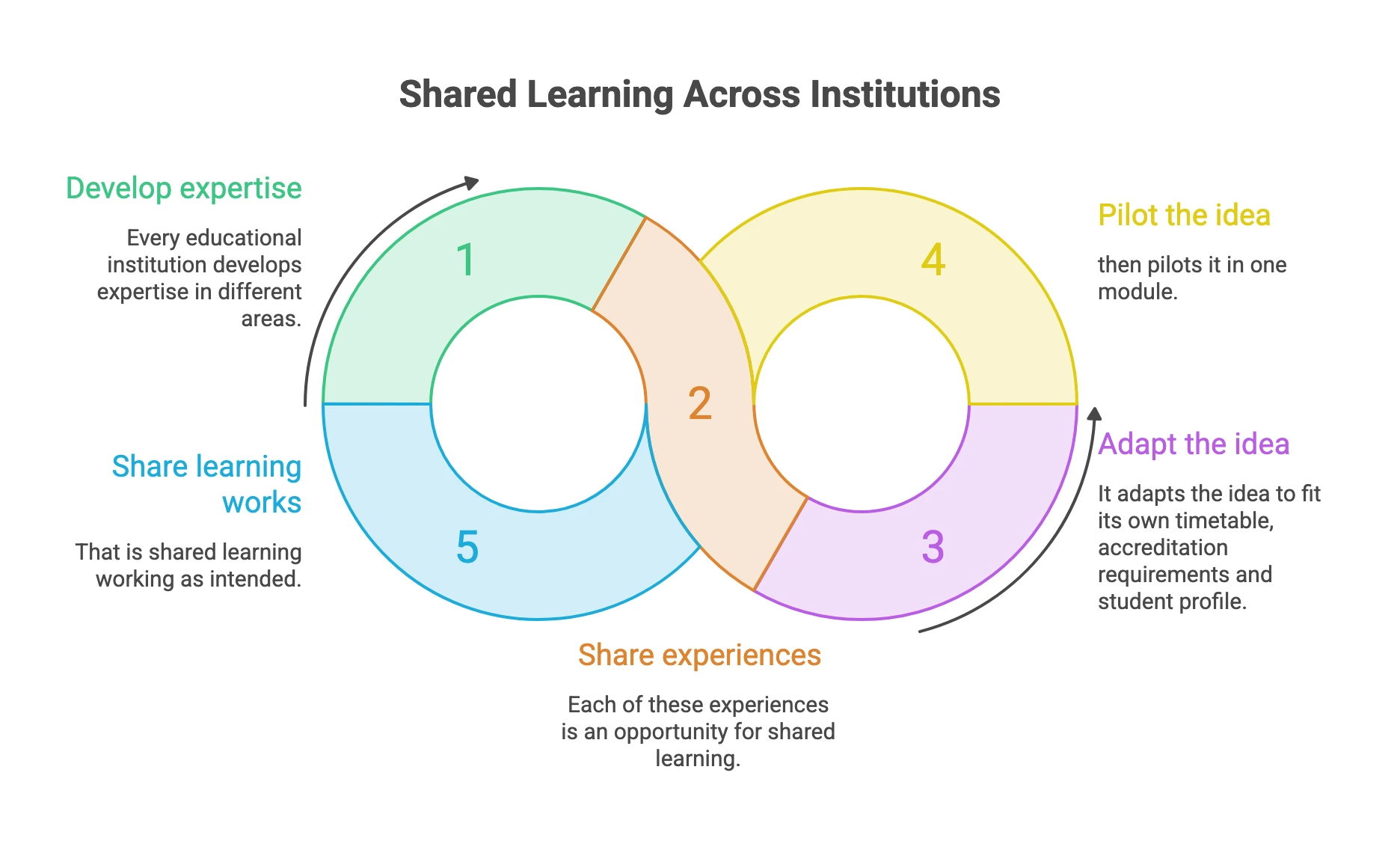
Every educational institution develops expertise in different areas. Some universities are recognised for research-led teaching. Others excel in industry partnerships, digital education, experiential learning or competency-based training. Vocational institutions often lead the way in practical skills development, while online education providers continue to pioneer flexible learning models.
Consider an illustrative example. A business school wants to improve employability outcomes. By speaking with a vocational college, its faculty learn how short, employer-supervised projects are built into each term. The school does not copy the model. It adapts the idea to fit its own timetable, accreditation requirements and student profile, then pilots it in one module. That is shared learning working as intended.
Innovation in curriculum design rarely happens in isolation. It grows through dialogue, collaboration and exposure to different perspectives. When faculty members engage with colleagues from other institutions, they meet new teaching methodologies, assessment strategies, curriculum frameworks and educational technologies. These conversations challenge assumptions, encourage creativity and often lead to practical improvements that benefit both educators and students.
Collaboration also helps institutions respond to emerging trends more effectively. By learning how institutions in different regions are integrating AI literacy, sustainability or entrepreneurship into their programmes, educators can make more informed curriculum decisions and avoid reinventing solutions that already exist.
Rather than waiting for change to become urgent, institutions that engage in continuous dialogue are often better prepared to anticipate future educational needs and respond proactively.
One of the greatest strengths of international collaboration is diversity. Education systems around the world approach teaching and learning in different ways. Some prioritise research and academic inquiry, while others emphasise practical application, community engagement or industry collaboration. Each perspective offers lessons that can enrich curriculum design.
Exposure to diverse ideas encourages educators to think more broadly about learning. It prompts questions about how students develop critical thinking, creativity, communication skills and adaptability, qualities that are increasingly important in today’s global workforce.
These discussions also remind institutions that there is rarely a single solution to an educational challenge. Progress often comes from combining different ideas, adapting successful approaches and creating learning experiences that reflect both global developments and local priorities.
Benchmarking is one of the most practical benefits of working with peer institutions. When you compare your programme structure, learning outcomes, assessment methods and graduate outcomes with those of similar institutions, you gain a clearer picture of where you are strong and where there is room to grow.
Good benchmarking is about learning, not ranking. It helps academic teams spot gaps, test their assumptions and justify changes with evidence. It also supports quality assurance, because institutions can show that their programmes were reviewed against external reference points rather than internal opinion alone.
Peer exchange can inform almost every part of curriculum development. The table below shows six areas where educators often find the most value, along with questions worth asking colleagues.
|
Area |
What to learn from peers |
Questions to ask |
|
Teaching methods |
Project-based, blended and experiential approaches |
How did you train staff? What changed for student engagement? |
|
Assessment |
Authentic, competency-based and formative assessment |
How do you keep standards consistent and fair? |
|
Industry alignment |
Employer input, placements and work-integrated learning |
How do you keep employer partnerships active? |
|
Emerging topics |
AI literacy, sustainability, digital skills, entrepreneurship |
Do you teach these as stand-alone modules or embed them? |
|
Learner support |
Tutoring, feedback and progress tracking |
Which supports had the greatest effect on completion? |
|
Interdisciplinary design |
Shared modules and cross-department projects |
How did you handle timetabling and staffing? |
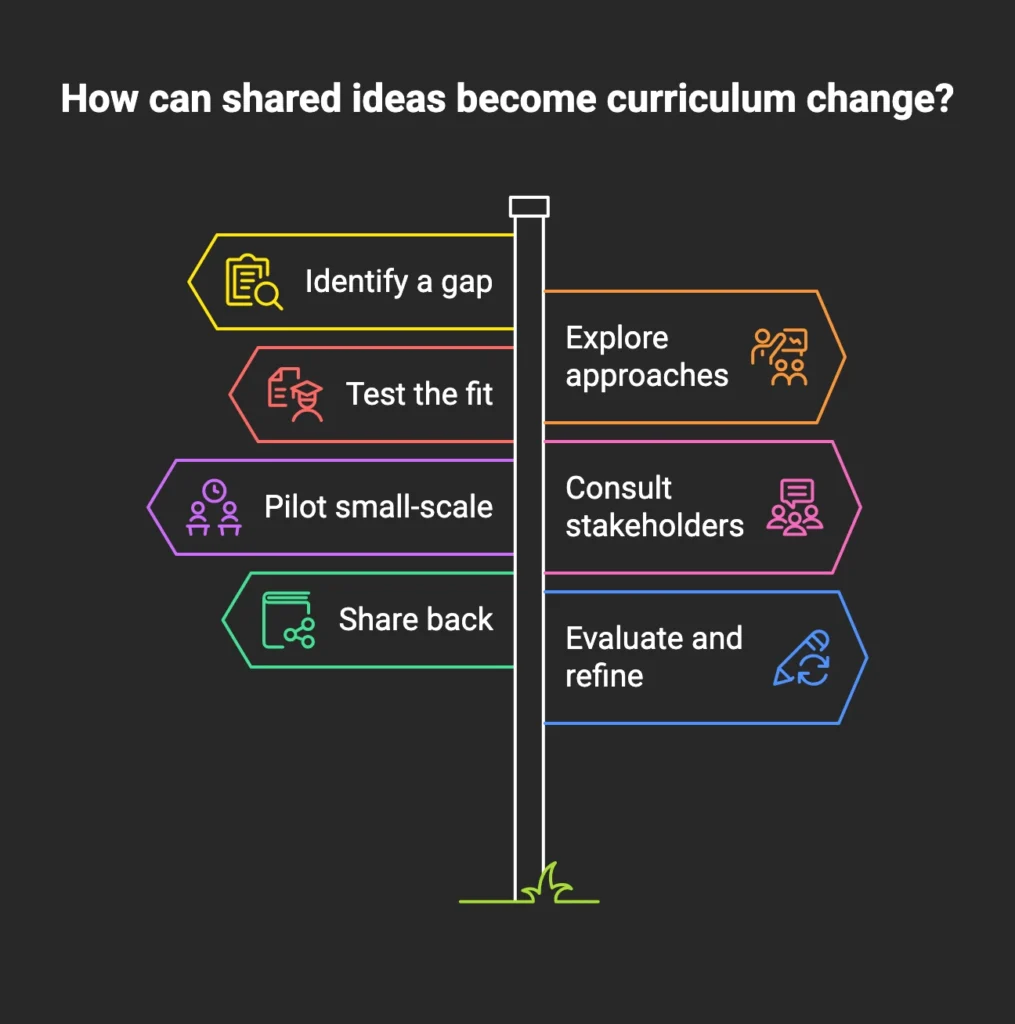
Good ideas only improve learning when they are applied carefully. A simple, repeatable process helps institutions move from inspiration to evidence-based change:
External collaboration only creates value when ideas travel back into the institution. Many colleges and universities encourage staff who attend conferences or webinars to share what they learned with their departments, through short briefings, internal workshops or written summaries.
Curriculum committees can also set aside time in each review cycle to look at examples from other institutions. Doing this regularly makes outside ideas a normal part of curriculum development, not an occasional extra. Over time, it builds a culture in which staff feel confident to question existing practice and propose improvements.
The International Association of Colleges & Universities (IACU) recognises that curriculum improvement is strengthened through collaboration. As a global membership association, IACU brings together universities, colleges, vocational institutions, online education providers and research organisations to create opportunities for professional dialogue and knowledge exchange.
Through its international network, educators and institutional leaders can connect with peers from different education systems, discuss emerging trends and share experiences that support academic development. Conferences, professional forums, workshops, webinars and collaborative discussions provide spaces where members can explore practical approaches to curriculum innovation, teaching excellence and institutional improvement.
These interactions are valuable because they encourage mutual learning. Every institution contributes its own experience while benefiting from the expertise of others, creating a culture where continuous improvement becomes a shared responsibility rather than an isolated effort.
Ultimately, curriculum development is about improving student learning. When educators engage with new ideas and stay connected to international developments, they are better equipped to design programmes that reflect current knowledge, industry expectations and the skills needed for future careers. Students benefit from more engaging learning experiences, relevant course content and teaching approaches that prepare them for an increasingly interconnected world.
Faculty members benefit too, by widening their professional perspectives and strengthening their ability to respond to changing needs. Institutions, in turn, become more adaptable, innovative and responsive to the expectations of students, employers and society.
Adopting an idea from another institution is only the first step. To know whether it has improved learning, institutions need to decide in advance how they will measure the result. Without clear evidence, even a well-intentioned change can become one more initiative that nobody reviews.
Useful indicators will vary by programme, but many institutions look at a mix of the following:
It helps to compare results with a baseline, such as the previous cohort, and to allow enough time for patterns to emerge. A single term rarely tells the whole story. Share what you find with your peer network too, including results that were modest. Honest evaluation makes the whole community’s knowledge stronger and helps other institutions decide what is worth adapting.
Higher education will keep evolving, and curriculum development must evolve with it. Institutions that embrace collaboration and shared learning will be better placed to keep their programmes relevant, innovative and aligned with a changing world.
The strongest curricula are not created in isolation. They are shaped by continuous reflection, professional dialogue and a willingness to learn from others. By engaging with a global community of educators through organisations such as IACU, institutions gain diverse perspectives that inspire meaningful improvements in teaching, learning and academic development.
Want to learn more about collaborating with a global network of institutions? Visit iacuglobal.org to discover what active membership can offer your institution.
This contributor is a recognized member of the IACU global expert network, sharing research-backed pedagogical models and vocational frameworks.