Online and hybrid learning have become established parts of higher education. Universities and colleges increasingly use digital platforms, virtual classrooms and blended teaching models to reach wider student groups, support flexible learning and expand programme delivery. However, providing courses through digital channels does not automatically guarantee a high-quality learning experience. Institutions must ensure that academic standards, teaching effectiveness, assessment integrity and student support remain consistent across every mode of delivery.
This makes quality assurance in online higher education an essential part of institutional planning rather than a process reserved for traditional campus-based programmes. Institutions need clear policies, defined responsibilities, reliable evidence and regular reviews to understand whether their online and hybrid programmes are achieving their intended outcomes.
A structured quality assurance framework can help institutions move beyond simply transferring classroom activities to digital platforms. It provides a systematic approach to designing courses, supporting learners, evaluating academic performance and making continuous improvements. By adapting established higher education quality principles to digital and blended environments, institutions can build programmes that are academically credible, accessible and responsive to student needs.
Quality assurance is the systematic process through which an institution monitors, evaluates and improves the quality of its educational activities. In online and hybrid higher education, this process must address both academic standards and the specific challenges associated with technology-enabled learning.
In a traditional classroom, students and lecturers interact in a shared physical environment. In online programmes, communication, teaching materials, assessment and student support may depend on digital systems. Hybrid programmes introduce another layer of complexity because students may experience the same course through different learning environments.
Without consistent quality controls, institutions may encounter differences in course delivery, unclear learning expectations, limited student engagement, accessibility barriers and inconsistent assessment practices. These issues can affect student progression and the achievement of programme learning outcomes.
Quality assurance helps institutions address these risks through documented academic policies, defined course standards, staff development, student feedback and regular programme reviews. It also helps ensure that the learning experience is not judged solely by the availability of technology, but by whether students receive effective teaching, appropriate academic support and fair opportunities to demonstrate their learning.
Importantly, online and hybrid programmes should be evaluated against the same academic expectations as other forms of higher education. The delivery method may differ, but the institution remains responsible for maintaining appropriate academic standards and demonstrating that students achieve the intended learning outcomes.
An effective quality assurance framework should connect academic planning, teaching, assessment, student support and institutional improvement. Institutions can organise their approach around five interrelated components.
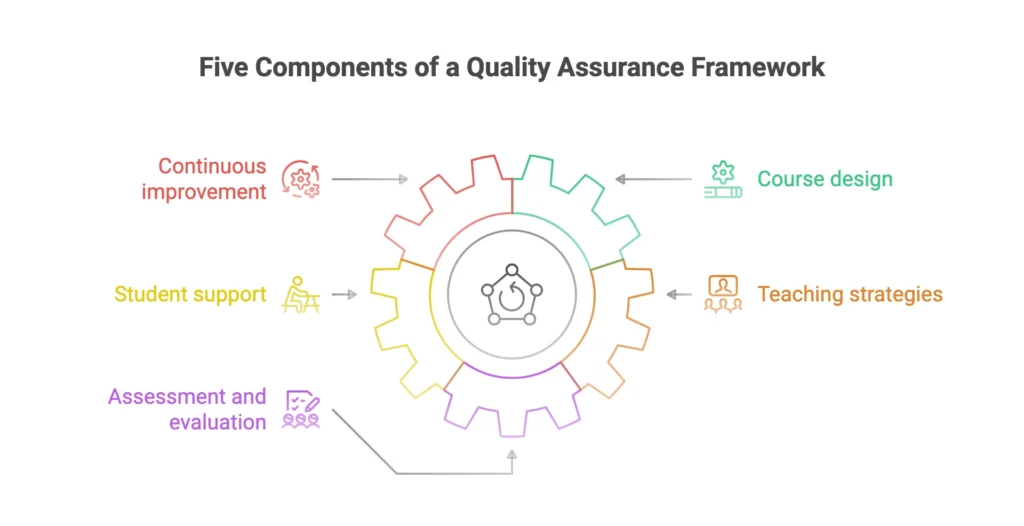
Quality begins before a course is delivered. Institutions should establish a consistent process for designing and approving online and hybrid programmes, ensuring that course content, learning activities and assessments are aligned with clearly defined learning outcomes.
Each course should communicate its objectives, structure, expected workload, assessment requirements and participation expectations. Learning materials should be relevant, accessible and organised in a way that allows students to navigate the course independently.
Institutions should also review whether the selected digital tools support the intended learning activities. A platform should not be chosen simply because it offers multiple features; it should help students access materials, interact with lecturers, participate in learning activities and complete assessments effectively.
Course development should involve academic staff, instructional designers and relevant support teams where appropriate. A documented approval process can help confirm that courses meet institutional expectations before they are made available to students.
Online teaching requires more than uploading lecture notes or recording classroom sessions. Institutions should establish teaching approaches that encourage participation, interaction and active learning.
Lecturers need to plan how they will communicate with students, facilitate discussions, provide explanations and monitor participation. Depending on the subject and programme structure, learning activities may include live sessions, recorded lectures, group projects, discussion forums, case studies and practical assignments.
Faculty development is equally important. Academic staff should receive appropriate guidance on digital teaching tools, online communication, inclusive teaching practices and the design of engaging learning activities.
For hybrid programmes, teaching strategies should also account for students participating remotely and those attending in person. Institutions should consider how both groups can access the same essential learning opportunities, interact with lecturers and participate in collaborative activities.
Assessment practices must demonstrate whether students have achieved the intended learning outcomes. Institutions should use appropriate formative and summative assessments and ensure that students understand how their work will be evaluated.
Assessment instructions, marking criteria and submission requirements should be communicated clearly. Rubrics can help make expectations transparent and support consistent evaluation across different lecturers and course sections.
Formative assessments, such as quizzes, practice tasks and draft submissions, allow students to understand their progress before completing major assessments. Summative assessments, including examinations, projects and final assignments, provide evidence of achievement at important stages of a programme.
Institutions should also establish procedures for moderation and academic review. These may include checking assessment tasks before delivery, reviewing marking decisions, comparing grading standards across groups and examining student work where appropriate.
Students studying online or through hybrid programmes need access to academic, technical and administrative support. Institutions should make these services easy to identify and use.
Academic support may include lecturer consultations, tutoring, guidance on assignments and access to learning resources. Technical support should help students resolve issues involving learning management systems, virtual classrooms, account access and digital learning tools.
Institutions should also consider accessibility when selecting platforms and preparing learning materials. Content should be organised clearly, and reasonable support should be available for students who experience barriers to accessing digital resources.
Clear communication is essential. Students should know where to seek help, how to contact relevant teams and when they can expect a response. Support arrangements should be reviewed regularly to identify recurring problems and opportunities for improvement.
Quality assurance should not end when a course is approved or a programme begins. Institutions need an ongoing process for reviewing performance and responding to evidence.
This involves collecting information from students, lecturers, programme teams and other relevant stakeholders. Institutions can examine assessment outcomes, course completion, retention, student feedback, support requests and teaching evaluations to identify areas that require attention.
Review findings should lead to documented improvement actions. For example, if students consistently report difficulties navigating a course, the institution may revise its learning platform structure or provide clearer guidance. If assessment results reveal gaps in learning outcomes, academic teams may review teaching materials or assessment design.
The important point is to establish a clear connection between evidence, decisions and improvements. A quality assurance system becomes meaningful when review findings lead to practical changes.
Institutions do not need to develop every quality indicator from the beginning. Established frameworks and course design tools can provide useful reference points when developing internal standards.
The Quality Matters (QM) Higher Education Rubric, for example, provides a structured approach to reviewing online and hybrid course design. Its Seventh Edition contains eight General Standards and 44 Specific Review Standards. These cover course introduction, learning objectives, assessment and measurement, instructional materials, learning activities and interaction, course technology, learner support, and accessibility and usability.
The rubric emphasises alignment between learning objectives, assessments, instructional materials and learning activities. This helps institutions examine whether the different elements of a course work together to support the intended learning outcomes. Quality Matters describes its rubric as a tool for course design review; it should not be confused with institutional or programme accreditation.
Another relevant reference is the Standards and Guidelines for Quality Assurance in the European Higher Education Area (ESG 2015). The ESG provides a framework for internal and external quality assurance and covers areas such as programme design and approval, student-centred learning, assessment, teaching staff, student support, information management and periodic programme review.
The ESG is designed for higher education regardless of the place or mode of delivery. Its principles can therefore inform institutional thinking about online and hybrid provision, although institutions must consider the regulatory and quality assurance requirements applicable in their own jurisdictions.
These frameworks should be used as references rather than treated as interchangeable certification systems. Institutions need to select and adapt appropriate standards according to their programme types, institutional context and applicable regulatory obligations.
Assessment integrity is one of the most important considerations in online higher education. Institutions must be able to demonstrate that assessment processes are fair, consistent and appropriate for measuring student achievement.
Online assessments can create challenges involving student identity, unauthorised assistance, plagiarism, collaboration rules and the secure handling of examination materials. Institutions should establish clear academic integrity policies that explain acceptable conduct, assessment expectations, misconduct procedures and the consequences of violations.
The assessment method should also be appropriate to the learning outcomes. Depending on the subject, institutions may use written assignments, presentations, oral examinations, practical demonstrations, supervised assessments or project-based evaluation. Using a variety of assessment methods can provide a broader picture of student achievement.
Where online examinations or remote invigilation are used, institutions should select processes that are proportionate to the assessment requirements and consistent with applicable privacy, accessibility and data protection obligations. Technology alone cannot guarantee academic integrity; clear policies, appropriate assessment design and academic oversight remain essential.
Moderation provides another important layer of quality control. Internal moderation can help ensure that assessment tasks are appropriate and that marking decisions are consistent. External examiners or independent subject specialists may also contribute to academic review where required by institutional policy or the relevant quality assurance system.
Institutions should maintain records of assessment design, marking criteria, moderation activities, examination procedures and decisions relating to academic integrity. These records help demonstrate that assessment is managed systematically and that identified concerns are addressed.
A quality assurance framework needs reliable information to evaluate whether online and hybrid programmes are working as intended. Learning analytics can support this process by helping institutions understand how students engage with digital learning environments.
Depending on the platform and institutional data policies, relevant indicators may include course participation, access to learning materials, assignment submissions, assessment performance, progression and completion. These indicators can help academic teams identify patterns that may require further investigation.
However, learning analytics should not be interpreted in isolation. A student who accesses a learning platform less frequently may still be making satisfactory progress through offline study or other approved learning activities. Data should therefore be considered alongside academic judgement, student feedback and the wider context of programme delivery.
Student surveys, lecturer feedback, course evaluations and discussions with programme teams can provide additional insight. Institutions may also gather feedback from graduates, employers or professional stakeholders where relevant to the programme.
A structured review process should translate these findings into improvement plans. Each action should have a clear purpose, a responsible person or team, an expected completion period and a method for checking whether the change has been effective.
Peer review can strengthen this process by allowing academic colleagues to examine course materials, teaching approaches and assessment practices. Periodic internal reviews can then evaluate whether improvements have been implemented and whether the programme continues to meet its objectives.
Hybrid learning combines online and in-person teaching, creating opportunities for flexibility but also requiring careful coordination. Students participating through different modes should have access to a coherent academic experience.
One common challenge is maintaining consistency between online and classroom-based activities. Institutions should ensure that learning outcomes, assessment expectations and essential course information remain aligned, even when teaching methods differ.
Communication also needs attention. Remote students may have fewer opportunities for informal interaction, while classroom-based students may receive immediate clarification from lecturers. Institutions should plan communication channels and participation activities that include both groups.
Faculty readiness is another important consideration. Teaching staff need to understand how to manage discussions involving remote and in-person students, use digital platforms effectively and adapt learning activities to different participation settings.
Institutions should also review their technology infrastructure, learning management systems, classroom equipment and technical support arrangements. Accessibility must remain a priority so that students can participate meaningfully regardless of their location or mode of attendance.
Regular feedback from both online and campus-based learners can help identify differences in their experiences. Institutions can use this information to improve teaching arrangements, support services and course design.
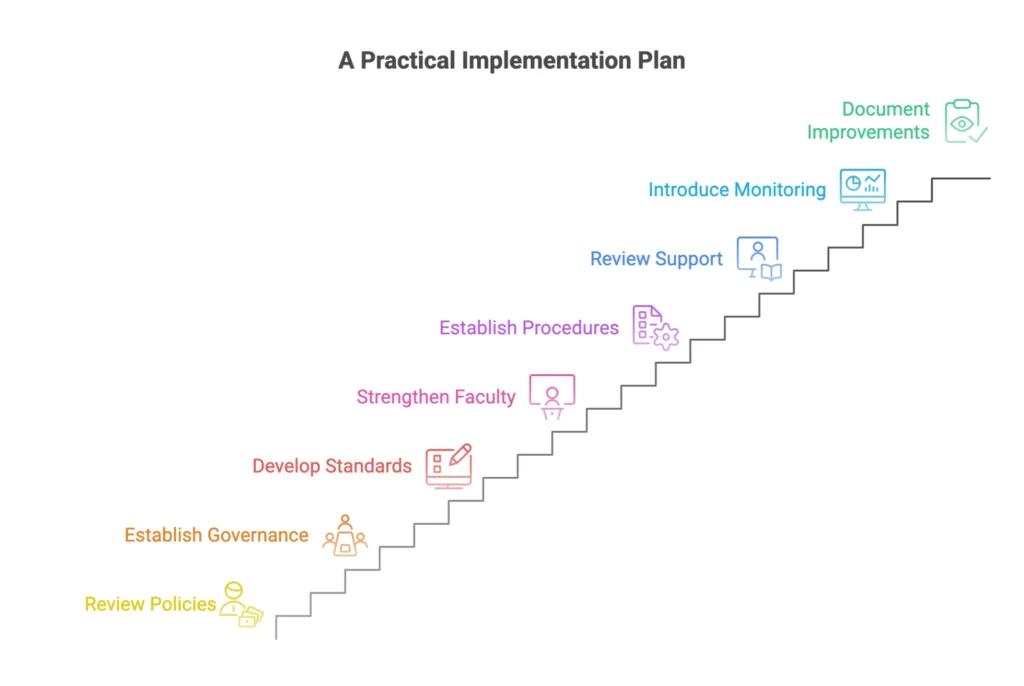
Building a quality assurance framework is an institutional process that requires planning, coordination and regular evaluation. The following steps provide a practical starting point.
Institutions can introduce these steps progressively. A phased approach allows teams to address immediate gaps, strengthen existing practices and develop a sustainable system of continuous improvement.
Documentation is an important part of institutional quality assurance. It allows institutions to demonstrate how academic decisions are made, how programmes are monitored and how identified issues are addressed.
For online and hybrid programmes, useful evidence may include programme approval records, curriculum maps, course outlines, learning outcomes, faculty qualifications, staff development records, assessment policies, moderation reports and student support procedures.
Institutions should also retain relevant student feedback, course evaluation findings, learning analytics reports, progression and completion data, peer review records and documented improvement plans.
Evidence should be organised so that it is easy to connect institutional policies with their implementation. For example, a policy describing assessment moderation should be supported by records showing how moderation was conducted and what actions followed from the findings.
Preparing this documentation as part of routine academic operations is more effective than collecting records only when an external review is approaching. It also helps institutions identify missing information and address weaknesses before they become larger problems.
It is important to distinguish internal quality assurance from external quality assurance. Internal QA is led by the institution through its own policies, committees, reviews and improvement processes. External QA involves evaluation by an appropriate independent agency or authority under the relevant national or regional system. The requirements, recognition and legal status of external bodies vary by jurisdiction, so institutions should verify the applicable procedures directly with the responsible authority.
Online and hybrid learning are now important parts of the higher education landscape. Their long-term success depends not simply on adopting digital platforms, but on establishing reliable academic systems that support effective teaching, fair assessment, student engagement and continuous improvement.
A structured quality assurance framework helps institutions connect these responsibilities through clear governance, consistent course design standards, academic oversight, student support and evidence-based review. By using relevant quality frameworks as references and adapting them to their own regulatory environments, institutions can strengthen the quality and consistency of their programmes.
The development of quality in higher education also benefits from professional dialogue and the exchange of institutional experiences. Global education networks can provide opportunities for universities, colleges, online education providers and academic professionals to connect, share knowledge and learn from different approaches to teaching and institutional development.
The International Association of Colleges and Universities (IACU) is a global membership association that supports professional connections, collaboration and knowledge-sharing among education institutions and professionals. It is a network for engagement and professional development, not an accreditation or regulatory authority.
Institutions and education professionals interested in international connections and shared learning can explore opportunities to engage with the IACU community.
Connect with the IACU global community to exchange knowledge, build professional relationships and explore opportunities for collaboration in higher education.
This contributor is a recognized member of the IACU global expert network, sharing research-backed pedagogical models and vocational frameworks.