
Online and hybrid education has become an important part of higher education, giving universities and digital education providers new ways to reach learners. But expanding access is only one part of building a successful digital institution. Students, employers, academic partners and regulators also need confidence in the quality and credibility of the education being delivered. Online university credibility depends on more than an attractive website, advanced learning technology or international marketing. It requires evidence of sound academic governance, transparent learning outcomes, qualified faculty and effective student support. For institutions looking to grow in the digital education landscape, credibility must be built into every stage of programme design, delivery and evaluation.
The shift towards digital learning has changed how institutions deliver education, but it has not reduced the expectations associated with academic quality. Whether a learner studies on campus, online or through a hybrid programme, they still need confidence that their education is meaningful, properly structured and supported by appropriate academic standards.
For students, choosing an online university involves important decisions about time, money and future opportunities. They need to understand what a programme offers, whether its qualifications are recognised in the relevant context and what support will be available throughout their studies.
Employers may want to understand the competencies graduates have developed. Academic partners may examine an institution’s governance, faculty expertise and programme standards before entering a collaboration. Regulators and quality assurance bodies expect institutions to meet applicable requirements and demonstrate accountability.
This makes credibility a strategic priority for digital-first institutions.
A university may have an advanced learning management system, a wide programme portfolio and an international digital presence. These features can improve accessibility and visibility, but they do not independently demonstrate academic quality.
Institutions need to connect their public claims with verifiable evidence. That means explaining their academic status accurately, publishing clear programme information, demonstrating faculty involvement and showing how student learning is supported and evaluated.
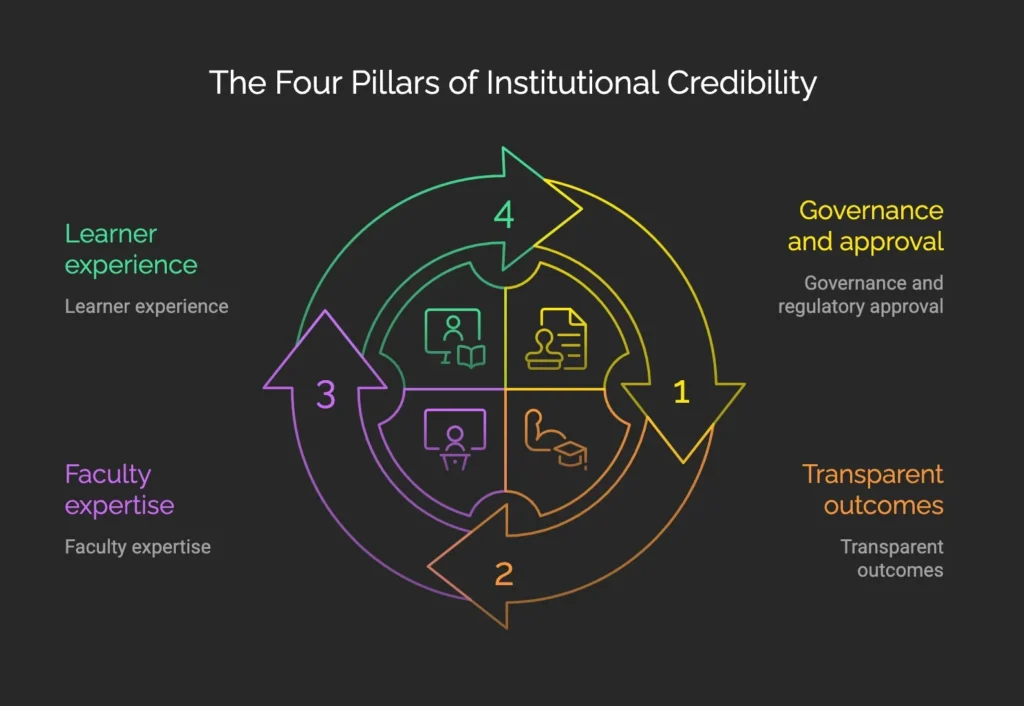
Institutional credibility in digital higher education is built through four connected areas: governance and regulatory approval, transparent outcomes, faculty expertise and learner experience. Together, these pillars provide a practical framework for evaluating how an institution establishes and maintains trust.
One of the most important questions stakeholders ask is whether an institution is authorised to operate and whether its programmes or qualifications have the recognition they claim.
These questions require careful distinctions. Government recognition, regulatory authorisation, accreditation and voluntary membership are not interchangeable.
For institutions working internationally, these distinctions are especially important. An organisation must understand the regulatory requirements that apply to its location, educational activities and intended student markets. It should also communicate its status accurately rather than using broad expressions such as “internationally recognised” without explaining what that recognition means.
Academic governance is another essential part of this pillar. University faculty and academic boards should retain appropriate authority over curriculum design, programme approval, degree requirements, academic policies and assessment decisions, even when external technology providers are involved.
Clear governance arrangements help institutions demonstrate that academic standards are managed through defined responsibilities and review processes.
Students need to understand what they will learn, how their progress will be assessed and what competencies they are expected to develop.
This begins with clearly defined programme-level learning outcomes. Each course should connect its learning objectives with teaching activities and assessment methods. When these elements are aligned, students can better understand the purpose of their learning activities and institutions can evaluate whether programmes are achieving their intended aims.
A transparent programme page should communicate:
Institutions should also consider how they communicate graduate outcomes. Where reliable data are available, information about graduation rates, employment outcomes, further study and competency development can help stakeholders understand programme performance.
However, outcome information must be presented with context. Institutions should explain how figures were collected, which student groups they represent and the period covered. Publishing an isolated employment percentage without explaining its methodology may create a misleading impression.
Digital credential systems can also support transparency. Frameworks such as India’s Academic Bank of Credits and digital verification services can help make academic records and credentials easier to manage and verify where applicable.
The objective is to make programme information understandable, accurate and supported by evidence.
Academic quality depends significantly on the people responsible for teaching, assessment and learner guidance. In digital education, faculty expertise must be supported by the ability to create engaging and effective online learning experiences.
Institutions should make faculty qualifications, subject expertise, professional experience and research interests visible to students and academic partners. Accurate academic profiles help stakeholders understand who is responsible for delivering and guiding a programme.
But visibility alone is not enough. Faculty members must also be actively involved in the learning experience.
Effective online teaching requires more than uploading lecture recordings or learning materials. Academics need to facilitate discussions, provide constructive feedback, guide students through challenging topics and identify learners who may need additional support.
Institutions can strengthen faculty involvement through:
Learning analytics can also help teaching teams understand student participation and identify patterns that may require attention. However, analytics should support academic judgement rather than replace meaningful communication between students and faculty.
Faculty development should therefore be treated as an ongoing institutional responsibility, not a one-time training activity.
A credible online programme needs to provide more than access to digital content. Students should be able to participate in meaningful learning activities, communicate with academic staff and access support when they encounter difficulties.
A well-designed digital learning environment may include interactive lessons, collaborative problem-solving, discussion forums, virtual learning resources and regular opportunities for feedback.
Accessibility must also be considered from the beginning of course design. Universal Design for Learning (UDL) offers a useful approach by encouraging institutions to provide multiple ways for learners to access information, engage with content and demonstrate their understanding.
Practical measures include accessible digital documents, alternative text for images, captions for recorded lectures and flexible ways to participate in learning activities.
Student support should extend beyond the virtual classroom. Institutions should consider academic counselling, technical assistance, digital library access, programme guidance and clear procedures for complaints and appeals.
A strong learner experience is not measured simply by the number of services available. What matters is whether students can access the right support at the right time and whether institutions use feedback to improve their services.
EdTech partnerships can help universities develop their digital capabilities without building every technical and operational function internally. Online Programme Management (OPM) providers may support course development, learning platforms, digital marketing, student recruitment and student services.
These partnerships can provide useful expertise and infrastructure, particularly for institutions transitioning from traditional delivery models.
However, operational support should not weaken academic oversight. Universities must retain appropriate control over the academic decisions for which they are responsible.
Before entering an EdTech or OPM partnership, institutions should examine five areas:
The institution should also review how the partnership affects the student experience. A technically efficient platform cannot compensate for unclear academic responsibilities or inadequate teaching support.
The strongest partnerships combine external expertise with clear institutional accountability.
Different stakeholders evaluate digital institutions from different perspectives. Students may focus on programme information and support, while employers may examine graduate competencies. Academic partners may be more interested in governance, faculty expertise and quality assurance practices.
Institutions should make relevant evidence easy to locate and understand.
Useful credibility signals include:
Third-party quality frameworks can provide additional reference points for institutions reviewing their academic practices.
For example, the Quality Matters Higher Education Rubric provides a structured approach to reviewing online and hybrid course design. Its standards address areas such as learning objectives, assessment, instructional materials, learner interaction, technology and accessibility.
The European Standards and Guidelines (ESG), developed for quality assurance in the European Higher Education Area, provide another important reference for internal and external quality assurance.
These frameworks serve different purposes and should be applied according to institutional context. Using a course-design rubric does not automatically mean an institution has received accreditation.
The important principle is to communicate exactly what a quality framework or external review demonstrates.
Building credibility does not require every institutional process to change simultaneously. A structured 90-day plan can help universities identify gaps, strengthen academic practices and make their evidence more accessible.
The first month should focus on understanding the institution’s current position.
Review:
Create an evidence register that records each institutional claim, its supporting documentation, the responsible department and the date of its last review.
Pay particular attention to website language. Business registration, voluntary membership and academic accreditation must be described accurately and separately.
The outcome of this phase should be a clear record of what the institution can demonstrate and which areas require improvement.
The second month should focus on strengthening the learning experience.
Institutions can introduce standardised instructional design templates to help teaching teams align learning objectives, learning activities and assessments.
Faculty development should also be prioritised. Workshops and ongoing support can help academics improve digital teaching, student engagement, assessment design and the use of learning technologies.
At this stage, institutions should also:
The goal is to ensure that the digital learning environment supports the academic objectives of each programme.
The final month should focus on making academic outcomes and institutional evidence more accessible.
Where reliable data are available, institutions can publish appropriately contextualised information about graduation rates, graduate outcomes and alumni feedback.
They can also review their digital credential processes and explore suitable verification systems, including relevant national platforms where applicable.
Further actions may include:
At the end of the 90 days, institutions should evaluate the improvements made, identify remaining gaps and assign responsibility for ongoing monitoring.
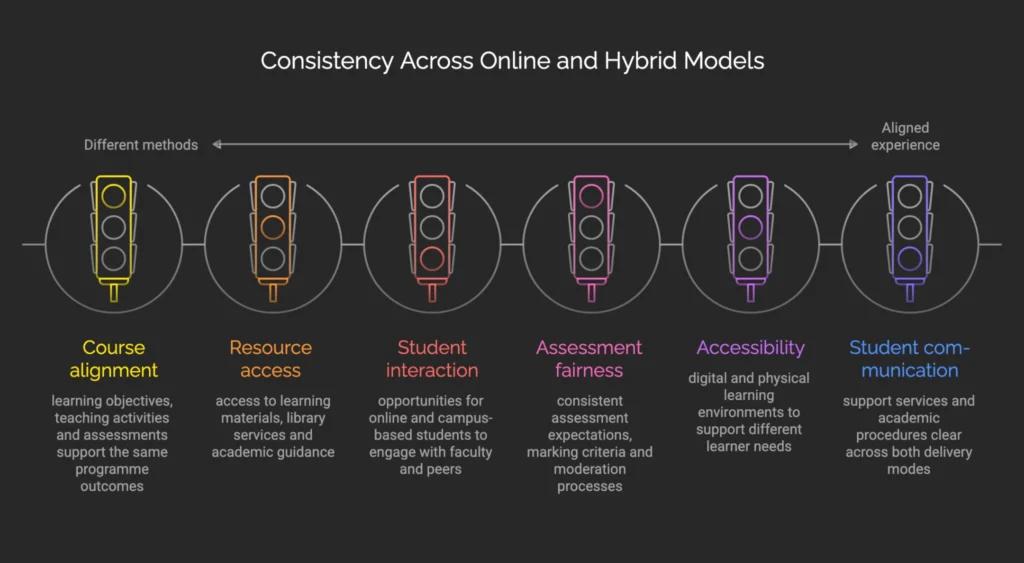
Hybrid higher education introduces an additional quality challenge: students may experience the same programme through different delivery methods.
A student attending a classroom session and another joining remotely should still have access to appropriate learning resources, academic guidance and fair assessment opportunities.
Consistency does not mean that online and in-person teaching must look identical. It means that the academic expectations and intended learning outcomes remain aligned.
Institutions should pay attention to:
Regular feedback from students in different learning environments can help identify gaps and improve the overall experience.
Institutions should also review whether technology, teaching practices and support services are working together effectively rather than evaluating them as separate functions.
Credibility should be communicated through clear information rather than broad promotional statements.
Instead of simply describing a university as internationally recognised or academically excellent, institutions should explain the evidence behind those claims.
This may include the relevant regulatory authority, the scope of an accreditation, the academic qualifications of faculty members, published programme outcomes or the services available to students.
The same principle applies to voluntary membership. An association membership may support networking, academic exchange and international visibility, but it should not be presented as statutory authorisation or academic accreditation.
Institutions should also measure credibility-related improvements over time. Useful indicators include:
No single indicator can demonstrate overall institutional quality. A stronger approach combines quantitative information with academic review, stakeholder feedback and documented improvement.
Even institutions with strong academic intentions can weaken stakeholder confidence through inconsistent communication or poorly managed processes.
Common mistakes include:
Avoiding these mistakes requires coordination between academic leadership, quality assurance teams, faculty, technology departments and communications teams.
Digital and hybrid higher education creates opportunities for institutions to expand access, build partnerships and reach new academic communities. However, sustainable growth depends on the quality and accountability behind the digital experience.
Institutions that strengthen academic governance, communicate transparent learning outcomes, invest in faculty development and provide meaningful learner support create a stronger foundation for stakeholder trust.
Credibility also requires clear communication about regulatory status, accreditation and voluntary membership. These distinctions matter because students and partners need to understand exactly what an institution’s credentials and affiliations represent.
For institutions seeking to strengthen their international academic connections, visibility and collaborative opportunities, IACU provides a network for universities, colleges, research centres, vocational institutions and online education platforms.
Get in touch with IACU for a credibility review of your programmes and audience, and explore practical ways to strengthen your institution’s position in the evolving digital higher education landscape.
This contributor is a recognized member of the IACU global expert network, sharing research-backed pedagogical models and vocational frameworks.