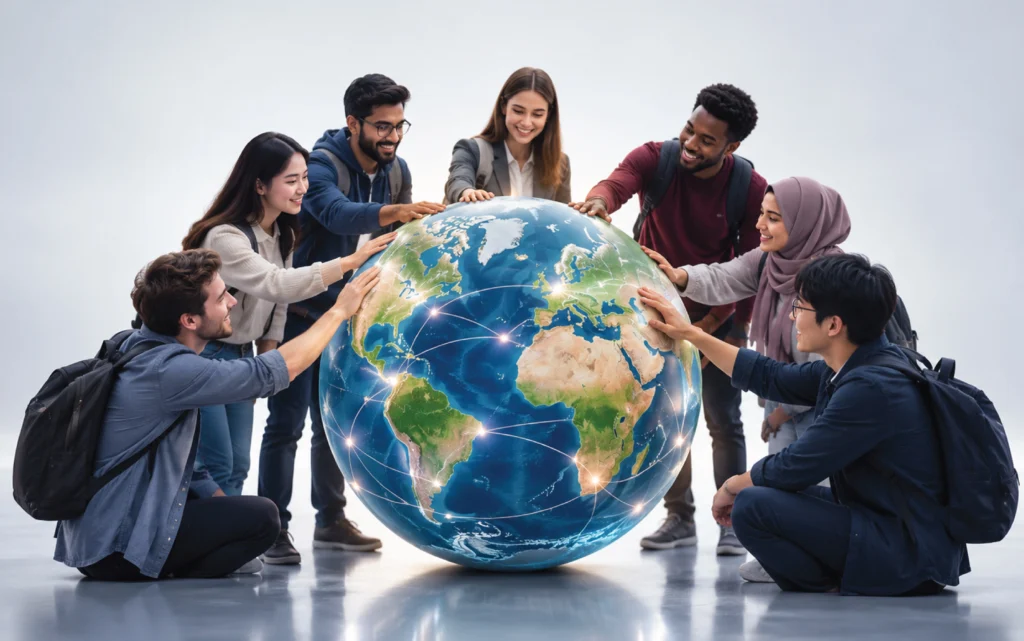
For centuries, universities and colleges have been places where ideas are exchanged, knowledge is created, and future generations are prepared to contribute to society. While every institution is deeply connected to its local community, higher education has never been limited by geography. Throughout history, scholars have travelled across borders to share knowledge, collaborate on research, and learn from different cultures. Today, technology has made those connections easier than ever, creating opportunities for institutions of every size to participate in a truly global academic community.
The challenges facing higher education today are no longer confined to one country or one region. Institutions across the world are adapting to digital transformation, integrating artificial intelligence into learning, preparing graduates for rapidly changing careers, strengthening research, and improving student engagement. Although each institution operates within its own cultural and educational context, many of these challenges are remarkably similar.
This shared reality has made international collaboration an essential part of institutional development. By connecting with educators and academic leaders from around the world, institutions gain access to new perspectives, practical experiences, and innovative ideas that can help shape their own future.
Every educational institution has something valuable to contribute. A university in one country may have developed an innovative approach to online learning, while another may excel in community engagement, industry partnerships, or student support services. A vocational institution may have created an effective model for workforce development, while a research university may offer insights into interdisciplinary collaboration.
When these institutions come together, they create opportunities to learn from one another rather than working in isolation. International academic communities encourage open dialogue where educators can discuss common challenges, share successful practices, and explore new approaches to teaching, research, and institutional leadership. These conversations broaden perspectives and often inspire practical improvements that can be adapted to local needs. Importantly, global collaboration is not about adopting another institution’s model without question. Every institution has its own mission, priorities, and community. Instead, it is about learning from diverse experiences and thoughtfully applying ideas that strengthen local education while respecting local contexts.
One of the greatest benefits of international engagement is exposure to different ways of thinking. Educational systems around the world differ in their policies, teaching methods, governance structures, and cultural traditions. These differences create valuable opportunities for reflection and innovation. By understanding how institutions in different regions approach similar challenges, educators are encouraged to examine their own practices with fresh perspectives.
For example, discussions about digital learning, student wellbeing, sustainability, graduate employability, or curriculum innovation often reveal creative solutions developed in different parts of the world. These shared experiences inspire educators to refine their own approaches while recognising that meaningful improvement is an ongoing process. Learning from international peers also encourages greater cultural understanding. It helps institutions appreciate the diversity of educational experiences and prepares both educators and students to work successfully in an increasingly interconnected world.
Successful international collaboration begins with relationships. Many meaningful academic partnerships start with a conversation at a conference, a webinar discussion, or a professional networking event. Over time, these conversations often develop into collaborative research projects, faculty exchanges, joint learning initiatives, curriculum development, or long-term institutional partnerships.
The value of these relationships extends far beyond individual projects. Strong professional networks provide ongoing opportunities to exchange ideas, seek advice, and remain connected to emerging developments across the global education sector.
For institutions, these relationships create a supportive environment where collaboration becomes a natural part of institutional growth rather than an occasional activity.
The International Association of Colleges & Universities (IACU) was established to support this spirit of international collaboration. As a global membership association, IACU brings together universities, colleges, vocational institutions, online education providers, and research organisations from different regions and educational systems. Rather than serving as an accreditation body, IACU provides a platform where institutions can connect, exchange knowledge, and build meaningful professional relationships. Through conferences, webinars, workshops, leadership forums, networking events, and professional discussions, members have opportunities to engage with educators and academic leaders who share a commitment to educational excellence and continuous improvement. These interactions encourage the exchange of ideas across cultures and disciplines, helping institutions broaden their perspectives while exploring opportunities for future collaboration.
International engagement offers benefits that extend throughout an institution. Faculty members gain access to professional learning opportunities and international networks that support teaching, research, and academic leadership. Institutional leaders gain insights into emerging trends, governance practices, and innovative approaches to higher education. Students ultimately benefit from richer learning experiences, broader perspectives, and educational environments that are better aligned with global developments.
At the same time, institutions strengthen their own reputation by demonstrating a commitment to continuous learning and meaningful collaboration. Active participation in international academic communities reflects an openness to innovation and a willingness to contribute to the advancement of higher education beyond national boundaries. This collaborative mindset helps institutions remain adaptable in an environment where change has become a constant feature of education.
The future of higher education will be increasingly interconnected. Advances in technology, greater mobility, and the growing exchange of knowledge mean that institutions can no longer view themselves as operating in isolation. The challenges and opportunities facing education today require cooperation, shared learning, and international dialogue.
Breaking down geographical barriers does not diminish the importance of local identity or community engagement. Instead, it strengthens institutions by adding new perspectives, encouraging innovation, and creating opportunities for mutual learning. Local knowledge becomes even more valuable when it is shared within a global context.
By participating in international academic communities such as IACU, institutions become part of a network that values collaboration over competition and shared progress over individual achievement. They gain opportunities to build lasting relationships, exchange ideas with educators from around the world, and contribute to a future.
This contributor is a recognized member of the IACU global expert network, sharing research-backed pedagogical models and vocational frameworks.