Every successful educational institution shares one common strength: its educators. Buildings, technology, and infrastructure certainly contribute to the learning environment, but it is faculty members who inspire students, encourage critical thinking, and transform knowledge into meaningful learning experiences. As higher education continues to evolve at an unprecedented pace, supporting the professional growth of educators has become more important than ever.
The role of a faculty member today extends well beyond delivering lectures. Educators are expected to integrate digital technologies into their teaching, respond to diverse student needs, design engaging learning experiences, encourage research and innovation, and prepare graduates for an increasingly complex and interconnected world. These expanding responsibilities make continuous professional development not just beneficial, but essential.
Professional development is no longer viewed as an occasional training session or a requirement for career advancement. Instead, it has become an ongoing process that enables educators to remain current, confident, and responsive to changes in higher education. Institutions that invest in faculty development are often better positioned to improve teaching quality, strengthen student outcomes, and foster a culture of innovation across their campuses.
Higher education is changing faster than ever before. The rapid growth of artificial intelligence, digital learning platforms, hybrid classrooms, competency-based education, and industry-focused curricula has transformed the way students learn and the way educators teach.
While these developments create exciting opportunities, they also require faculty members to continuously update their knowledge and teaching practices. Even experienced educators benefit from exploring new instructional strategies, learning technologies, assessment methods, and approaches to student engagement.
Professional development provides the space to reflect on existing practices while discovering new ideas that enhance teaching effectiveness. It encourages educators to experiment, adapt, and refine their methods in ways that better support student learning.
Importantly, faculty development is not about replacing traditional teaching practices. It is about equipping educators with a broader range of tools and perspectives so they can respond effectively to changing educational needs while maintaining academic quality.
A generation ago, teaching effectiveness was often judged primarily by subject mastery and classroom presence. Today, that picture is far more layered. Faculty members are expected to be curriculum designers, technology adopters, mentors, researchers, and sometimes even student wellbeing advocates, all within the same role.
This shift places new demands on time and skill. An educator may need to learn how to structure a hybrid classroom that serves both in-person and remote learners equally well, or how to use data from digital platforms to identify students who are struggling before a problem becomes serious. None of these skills are typically covered in a single training session; they develop over time through sustained learning, practice, and reflection.
Recognizing this shift is the first step for institutions. Faculty development programmes that assume the old model of teaching, one built solely around lectures and exams, quickly become outdated. Programmes that instead treat teaching as a constantly evolving craft give educators the tools to keep pace with legitimate change rather than reacting to it after the fact.
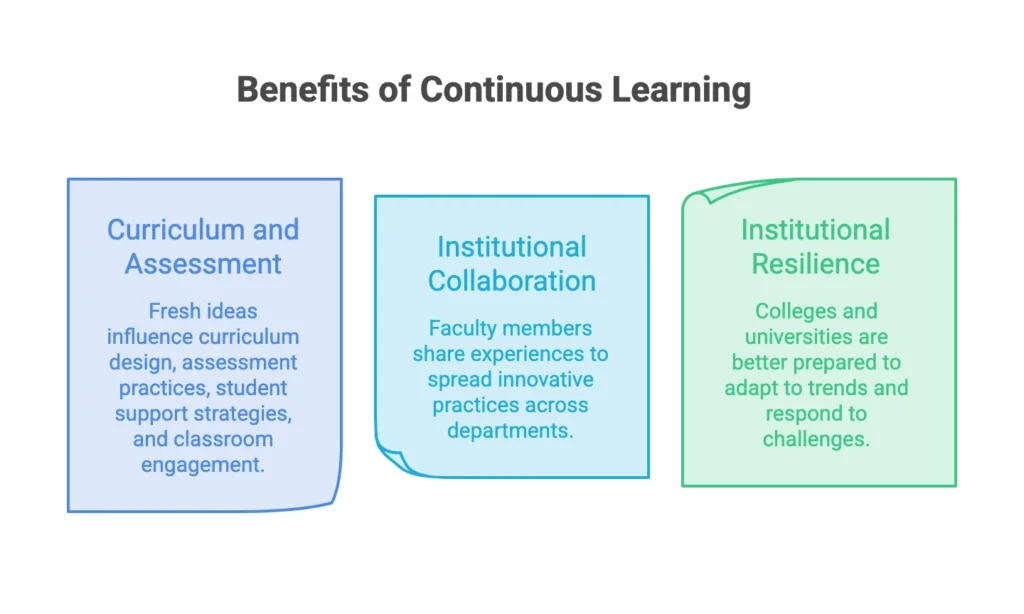
When institutions invest in their educators, the benefits extend far beyond individual faculty members. Educators who participate in professional learning often return with fresh ideas that influence curriculum design, assessment practices, student support strategies, and classroom engagement. These improvements contribute to stronger academic programmes and create more dynamic learning environments for students.
Professional development also encourages collaboration within institutions. Faculty members who share their experiences with colleagues help spread innovative practices across departments, creating a culture where learning becomes a shared institutional value rather than an individual responsibility.
This culture of continuous improvement strengthens institutional resilience. Colleges and universities that encourage lifelong learning among their faculty are generally better prepared to adapt to emerging trends, respond to educational challenges, and embrace innovation with confidence.
One of the most overlooked benefits of faculty development is what happens after the workshop or conference ends. A single educator who learns a new assessment technique or a fresh approach to student engagement rarely keeps that knowledge to themselves. In healthy academic environments, ideas travel through department meetings, informal conversations in faculty lounges, and mentorship between senior and junior staff.
Over time, this informal sharing becomes something more structured. Institutions that recognize the value of these exchanges often build formal mechanisms around them, such as peer observation programmes, teaching circles, or internal showcases where faculty present what they have learned from external development opportunities. These mechanisms turn individual professional growth into a multiplier effect across the entire institution.
The result is a kind of institutional memory that outlasts any single hire or retirement. When learning is embedded into the culture rather than treated as an occasional event, an institution becomes less dependent on any one person’s expertise and more resilient as a collective body of practice.
One of the greatest advantages of professional development today is the opportunity to learn from educators working in different parts of the world. Although education systems vary across countries, many institutions face similar challenges: improving student engagement, integrating technology, supporting inclusive learning, enhancing graduate employability, and responding to rapidly changing workforce expectations.
Connecting with international peers allows educators to discover practical approaches that have proven successful in other contexts. These exchanges broaden professional perspectives while encouraging thoughtful discussions about teaching, leadership, curriculum development, and institutional improvement.
Learning from global experiences also reminds educators that innovation does not always require major structural change. Often, small ideas shared through professional dialogue can inspire meaningful improvements within individual classrooms and institutions.
Higher education has always had an international dimension, but the pace of global exchange has accelerated. Students increasingly study across borders, either physically or through online programmes, and graduates are expected to work in interconnected, multicultural environments. Faculty who have themselves engaged with international peers are often better equipped to prepare students for that reality.
There is also a practical benefit to cross-border learning that goes beyond cultural exposure. An institution in one country may have already solved a problem that another institution is only beginning to face, whether that is designing accessible online assessments, building industry partnerships for practical training, or restructuring a curriculum around competency-based outcomes. Faculty development networks that span countries and institutions shorten the distance between a problem and a proven solution.
These exchanges work best when they go beyond one-off conference attendance. Ongoing forums, working groups, and mentorship connections allow ideas to be tested, adapted, and refined over multiple conversations rather than absorbed once and forgotten.
The International Association of Colleges & Universities (IACU) recognizes that strong institutions are built by educators who continue to learn throughout their careers. As a global membership association, IACU provides opportunities for faculty members, academic leaders, and administrators to engage with a diverse international community committed to educational excellence.
Through its professional development initiatives, members can participate in training programmes, workshops, webinars, conferences, leadership forums, and academic discussions covering a wide range of topics. These include innovative teaching practices, digital transformation, academic leadership, quality enhancement, student-centred learning, curriculum development, and institutional growth.
More importantly, these activities create opportunities for educators to exchange experiences with colleagues from different educational systems and cultural backgrounds. Rather than focusing solely on theory, discussions often centre on practical challenges and real-world experiences that institutions can adapt to their own environments.
The value of these interactions lies not only in acquiring new knowledge but also in building lasting professional relationships that continue beyond individual learning events.
Institutions that get the most value from faculty development tend to treat it as a strategy rather than a series of disconnected events. This starts with identifying the specific skills and knowledge gaps that matter most to an institution’s mission, whether that is strengthening research output, improving retention rates, or modernizing a particular department’s curriculum.
From there, development opportunities can be sequenced rather than scattered. A newer faculty member might begin with foundational training in instructional design and classroom management, then progress toward more specialized areas such as blended learning design or academic leadership as their career develops. This progression mirrors how professional development already works in many other fields, where early-career training looks very different from mid-career or senior-level learning.
Institutions should also consider how they measure the impact of professional development, beyond simply tracking attendance. Meaningful measures might include changes in student feedback, adoption of new teaching techniques in the classroom, or increased collaboration across departments. These indicators help institutions understand whether their investment in faculty is translating into real improvements rather than just checking a box.
Even institutions that genuinely value professional development often run into practical obstacles. Time is usually the biggest one. Faculty members balance teaching loads, research commitments, administrative duties, and student advising, leaving little room for additional learning unless it is deliberately built into their schedules.
Budget constraints present another common barrier, particularly for smaller institutions or those in regions where travel to international conferences is costly. Here, membership in global associations and access to virtual workshops, webinars, and online forums can offer a more affordable way to reach the same international perspectives that in-person events provide.
A third barrier is simply uncertainty about where to start. Faculty members are sometimes offered a long list of optional trainings with little guidance on which would be most useful for their specific role or career stage. Institutions that pair development opportunities with clear guidance, and ideally with input from mentors or department heads, tend to see much higher engagement than those that leave the choice entirely open-ended.
Addressing these barriers does not require unlimited resources. It requires intentional scheduling that protects time for learning, a mix of low-cost and higher-investment opportunities, and clear pathways that help faculty understand which development activities align with their goals.
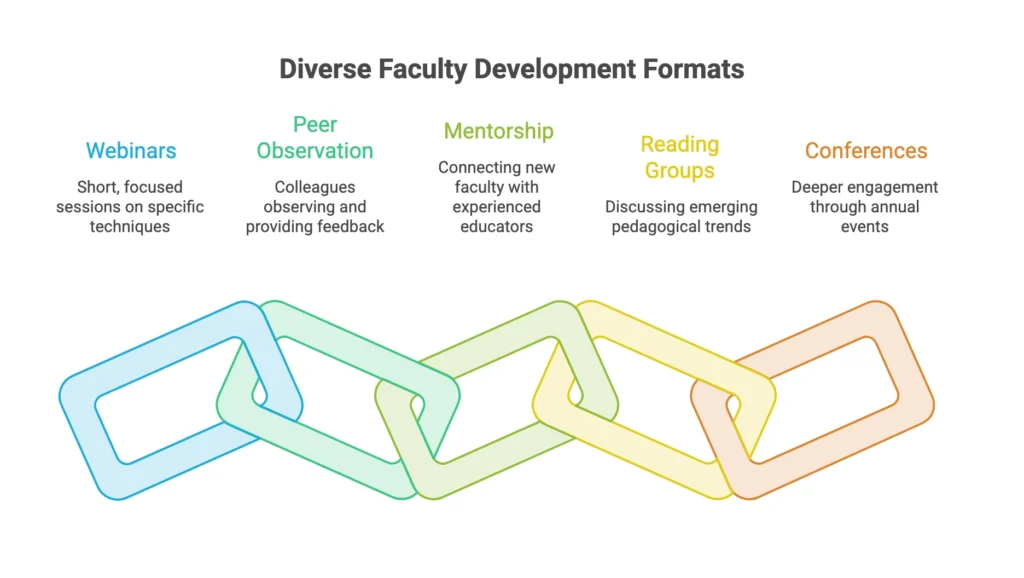
Professional development does not have to mean a week-long conference or a formal certification programme, though both have their place. Some of the most effective learning happens through smaller, recurring formats that fit more naturally into a busy academic calendar.
A mix of these formats, rather than reliance on any single one, tends to serve different learning styles and time constraints across a faculty body. Newer educators may benefit most from mentorship and short webinars, while senior faculty and academic leaders may find more value in leadership forums and cross-institutional exchange.
Institutions that curate this mix deliberately, rather than leaving faculty to seek out opportunities entirely on their own, tend to see more consistent participation and a stronger sense that development is a shared institutional priority rather than a personal side project.
Faculty development does not happen in a vacuum. Department chairs, deans, and academic leaders play a central role in either enabling or unintentionally discouraging participation. When leaders openly participate in professional development themselves, rather than treating it as something only newer or junior faculty need, it signals that learning is valued at every career stage.
Academic leaders can also help by recognizing professional development in the same way research output or teaching evaluations are recognized, whether through formal acknowledgment in performance reviews, protected time in teaching schedules, or funding support for conferences and memberships. Without this kind of institutional backing, even well-designed development opportunities can go underused.
Ultimately, sustaining a culture of continuous learning requires alignment from the top of an institution to the classroom level. Leadership sets the tone, but it is the everyday choices of faculty, whether to attend a workshop, mentor a colleague, or try a new teaching method, that determine whether that culture actually takes root.
The future of higher education will continue to evolve alongside technological innovation, changing learner expectations, and global societal needs. Institutions that thrive will be those that view faculty development as a long-term investment rather than a short-term initiative.
Supporting educators means creating opportunities for them to grow as teachers, mentors, researchers, and academic leaders. It also means encouraging curiosity, collaboration, and a willingness to embrace change while preserving the core values of quality education.
Professional development is ultimately about empowering educators to achieve their full potential. When faculty members grow professionally, students benefit from richer learning experiences, institutions become more innovative, and the education sector as a whole becomes stronger.
As higher education looks toward the future, one truth remains constant: investing in educators is one of the most valuable investments any institution can make. By fostering continuous learning and connecting with global professional communities such as IACU, institutions strengthen not only their faculty but also their capacity to deliver meaningful, high-quality education for generations to come.
This contributor is a recognized member of the IACU global expert network, sharing research-backed pedagogical models and vocational frameworks.