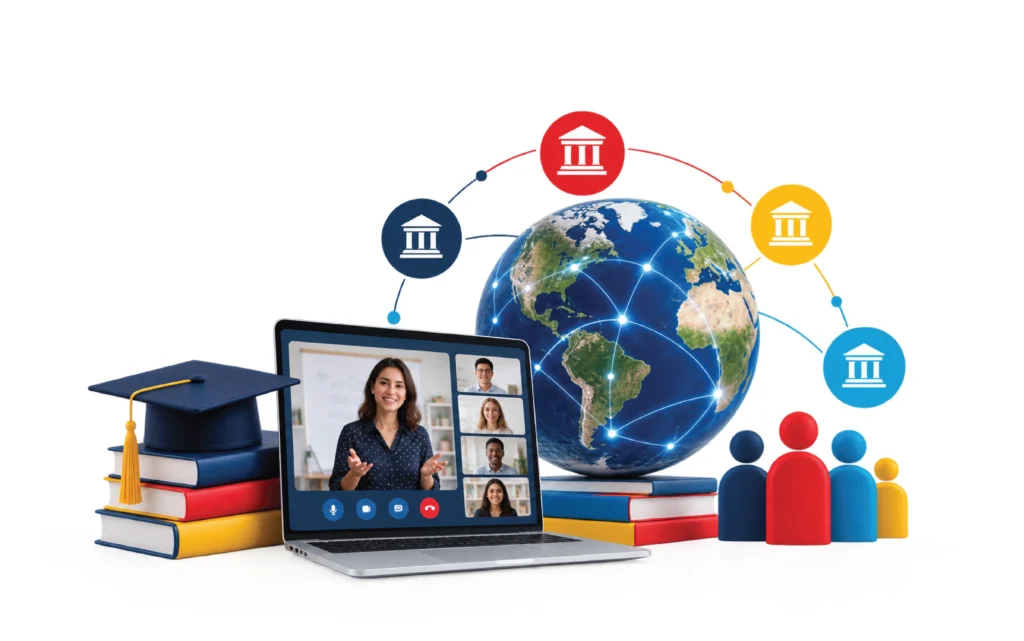
The digital revolution has changed education in ways that would have seemed unimaginable only a decade ago. Learning is no longer tied to a physical classroom, a fixed timetable, or a single geography. A student in Lagos can enrol in a course built by an instructor in Toronto, complete a professional certification from a platform based in Singapore, and collaborate on group work with classmates scattered across a dozen countries all without leaving home. This shift has not happened by accident. It is the product of online education platforms that have spent years building the infrastructure, content, and communities that make borderless learning possible.
From full online degree programmes run by established universities to specialised platforms offering short courses and professional certifications, digital education has dramatically expanded who gets to learn, when they learn, and how far their opportunities can reach. Yet as the sector matures and competition intensifies, it is becoming clear that success is no longer just a function of clever technology or a slick learning interface. It increasingly depends on something less visible but just as important: how well connected a platform is to the wider academic and professional community it serves.
It is easy to assume that online education is primarily a technology business after all, the product is delivered through a screen, powered by algorithms, hosting, and clever user interfaces. But behind every platform that learners genuinely trust and return to, there is a much larger and more human effort at work: instructional designers shaping how content is sequenced, subject matter experts making sure material stays current, academic leaders setting quality standards, and support staff solving problems learners run into along the way.
Modern learners expect far more than a library of pre-recorded videos. They want learning environments that feel alive courses that are genuinely engaging, curricula that reflect what employers actually need, support that responds quickly, and credentials that carry real weight once they enter the job market. Meeting expectations like these requires constant iteration, not just in the underlying software but in pedagogy itself: how assessments are designed, how learner engagement is measured and improved, and how programmes evolve to keep pace with a fast-changing world of work.
This is precisely why online education providers benefit enormously from staying connected to the broader education sector rather than building in isolation. When a platform’s team only talks to itself, its blind spots calcify. Exposure to different institutions, different disciplines, and different regions forces a platform to test its assumptions, discover new approaches, and adapt more quickly to the needs of learners who are themselves incredibly diverse.
One of the defining strengths of online education is that it was, in many ways, born global. Unlike a physical campus that draws students from a limited catchment area, a digital platform can attract a learner base spanning dozens of countries, cultures, and professional backgrounds from day one. It only makes sense that the institutions behind these platforms should think just as globally about where they get their own ideas and inspiration.
Around the world right now, educators and institutions are experimenting with strikingly different solutions to the same underlying challenges. Some are exploring how artificial intelligence can personalise learning paths responsibly, without compromising academic integrity. Others are refining quality assurance frameworks for fully online programmes, or building new models for keeping remote learners engaged over the long haul. Each of these experiments, whether it succeeds spectacularly or fails instructively, generates knowledge that other institutions can learn from but only if there is a channel through which that knowledge can travel.
This is where being part of a global professional community becomes genuinely valuable. Rather than every platform reinventing the wheel in isolation, institutions that are plugged into an international network can draw on the accumulated experience of peers who have already faced similar problems. Ideas move faster. Mistakes get repeated less often. And the entire sector inches forward more efficiently than it would if every organisation worked entirely on its own.
For an online education provider, this kind of exposure also has a practical, day-to-day benefit: it keeps the organisation informed. The pace of change in digital education is unrelenting, and it is remarkably easy for a platform focused purely on its own operations to fall behind on developments that are reshaping the wider landscape. Staying connected to a global community acts as an early warning system, surfacing shifts in learner expectations, regulatory environments, and technology long before they become urgent problems.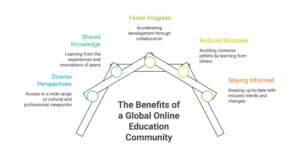
Strong professional relationships have always mattered in education, and digital learning is no exception. If anything, the relationships matter more, precisely because online platforms can otherwise operate at a distance from the traditional academic institutions, accrediting bodies, and industry partners that shape the broader sector.
Membership in a global association opens the door to exactly these kinds of relationships. It creates opportunities to connect with universities, colleges, vocational training providers, research organisations, and academic leaders people and institutions that bring perspectives an online only platform might never encounter on its own. These connections foster an environment where ideas circulate freely, where a platform built around bite-sized professional certifications can learn something valuable from a century-old research university, and vice versa.
The International Association of Colleges & Universities (IACU) is one example of an organisation built specifically to support this kind of collaborative environment. IACU brings together a diverse, international community of educational institutions and professionals, functioning as a space for dialogue, knowledge sharing, and professional engagement rather than as an accrediting body. For an online education provider, membership in an association like this means gaining access to conversations that extend well beyond the world of digital learning alone.
Members find themselves engaging with educators working across entirely different sectors of education from vocational training to postgraduate research and gaining broader perspectives on curriculum development, institutional leadership, quality enhancement, and student support along the way. These are the kinds of insights that rarely surface through internal team meetings or competitor analysis, because they come from people solving genuinely different problems in genuinely different contexts.
One of the most tangible benefits of association membership is the way it turns casual professional conversations into concrete partnerships. Many of the most successful educational initiatives in recent years did not start as formal projects they started as a conversation between two people at a conference, a shared observation during a webinar panel, or an email exchange that followed a chance introduction.
Institutions that engage actively in these communities routinely discover shared interests they did not know they had, exchange experiences that shortcut months of trial and error, and identify opportunities to work together that neither party would have found independently. Over time, relationships like these can develop into collaborative learning initiatives, joint academic projects, faculty exchange programmes, shared research activities, or simply the sharing of educational resources that would otherwise have taken significant time and money to build from scratch.
For online education platforms specifically, collaboration with traditional universities, vocational institutions, and specialised training providers opens up possibilities that would be difficult to access alone. A digital platform might gain credibility and academic rigor by partnering with an established university; the university, in turn, might gain reach and flexibility by working with a platform that already has the technology and learner base to scale a programme quickly. Partnerships like these thrive precisely because they combine different strengths rather than duplicating the same ones.
It is worth stressing that this kind of collaboration is not reserved for large, established players. Smaller online learning organisations and newer education platforms frequently bring exactly the kind of agility and fresh thinking that larger, more established institutions lack. In a genuinely open professional community, size matters far less than the quality of the ideas and the willingness to contribute them.
As digital education matures as a sector, credibility has become one of its most valuable currencies. Learners are more discerning than ever about where they invest their time and money. Employers are increasingly cautious about which credentials they trust. Institutional partners want to know that the organisations they work with are serious, transparent, and committed to more than short term growth.
Active participation in professional communities is one of the most effective ways to build this kind of credibility, precisely because it cannot be manufactured through advertising alone. When a platform contributes to educational discussions, shares what has worked in its own programmes, and engages meaningfully with international peers, it sends a signal that is difficult to fake: that the organisation genuinely cares about advancing education, not just about acquiring customers.
Visibility built this way tends to compound over time. Every conference session, webinar panel, leadership forum, or workshop a platform participates in adds another layer to its professional reputation within the global education community. And recognition earned through this kind of sustained, substantive contribution tends to carry far more weight with learners, with partners, and with employers than recognition purchased through marketing spend alone.
The next chapter of online education will not be written by technology alone. Artificial intelligence, immersive and simulation-based learning environments, micro-credentials, deeply personalised learning paths, and an accelerating shift toward lifelong learning are all set to reshape how education is delivered over the coming years. But no single institution, however well-resourced, can track every one of these developments in isolation and respond to all of them wisely.
Institutions that remain plugged into global professional networks are simply better positioned to understand these shifts as they unfold and to respond to them thoughtfully rather than reactively. They hear about emerging approaches earlier. They can test ideas against the experience of peers before committing significant resources. And they build the kind of relationships that make collaboration on genuinely new initiatives possible, rather than having to develop every capability internally from a standing start.
Global association membership provides a durable foundation for exactly this kind of ongoing engagement. By connecting with educators, academic leaders, and institutions across different regions and different corners of the education sector, online education providers gain access to fresh ideas, wider perspectives, and professional relationships that support growth well beyond any single product cycle or marketing campaign.
Ultimately, the strength of a digital education platform rests not only on the sophistication of its technology, but on the strength of the community standing behind it. Through active collaboration, genuine knowledge sharing, and sustained participation in international networks such as IACU, online education platforms can keep innovating, keep earning trust, and keep contributing to a more connected, more inclusive future for education as a whole.
This contributor is a recognized member of the IACU global expert network, sharing research-backed pedagogical models and vocational frameworks.