In today’s higher education landscape, an institution’s reputation extends far beyond the walls of its campus. While academic excellence, research output, and student success remain essential indicators of quality, they are no longer the only factors that shape how an institution is perceived. Increasingly, global recognition is influenced by an institution’s ability to engage with the wider academic community, contribute to meaningful conversations, and build relationships that cross national and cultural boundaries. For many institutions, joining an international university association or a broader higher education association has become one of the most effective ways to achieve this kind of visibility.
The rapid internationalisation of higher education has transformed the way institutions connect with one another. Students seek globally relevant learning experiences, employers value graduates with international perspectives, and academic partners look for institutions that demonstrate openness to collaboration and innovation. In this environment, building a global profile is not reserved for large universities with extensive international campuses. Regional colleges, vocational institutions, specialised academies, and online education providers also have valuable contributions to make—and many are finding that meaningful engagement through a structured university membership program is the key to expanding their visibility.
Beyond Reputation: Building Meaningful Recognition
Global recognition is often misunderstood as achieving international rankings or attracting large numbers of overseas students. While these achievements can certainly enhance an institution’s profile, genuine recognition is built through credibility, relationships, and consistent engagement.
Institutions that actively participate in the global education community become known not simply for what they offer, but for what they contribute. Sharing innovative teaching practices, presenting successful institutional initiatives, participating in academic discussions, or collaborating on joint projects all demonstrate an institution’s commitment to advancing education beyond its own campus. This is precisely the value proposition offered by a well-run international higher education association: it gives institutions a structured, credible platform through which their contributions can be seen and recognised by peers around the world.
This type of recognition develops gradually. It grows through professional relationships, shared experiences, and a willingness to engage with educators and institutions facing similar opportunities and challenges. Over time, these interactions establish trust, strengthen professional networks, and position institutions as active contributors to the global higher education community. Institutions that treat their university membership as a passive credential rather than an active relationship tend to see limited returns; those that engage consistently see compounding benefits over years, not months.
The Power of International Collaboration
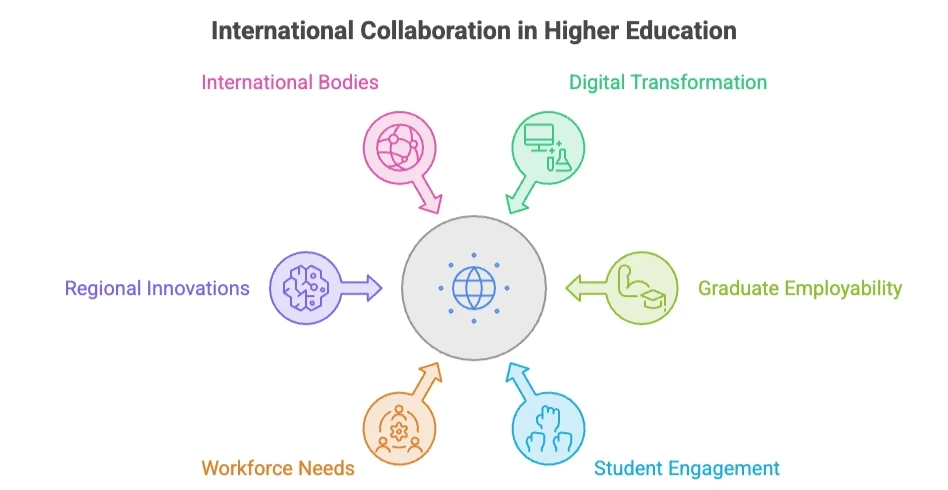
No institution operates in isolation anymore. Across the world, colleges and universities are responding to similar challenges- embracing digital transformation, improving graduate employability, enhancing student engagement, and adapting to rapidly changing workforce needs.
Although these challenges may be shared, the solutions often emerge from different educational contexts. An institution in Asia may pioneer innovative approaches to digital learning, while a university in Europe develops new strategies for interdisciplinary education. A vocational institution in Africa might establish strong industry partnerships that inspire similar initiatives elsewhere. A national higher education association might excel at coordinating domestic policy engagement and local accreditation alignment, but it is often the international bodies that connect these regional innovations into a single, cross-border conversation.
When institutions connect internationally, these experiences become valuable learning opportunities. Collaboration enables educational leaders to exchange ideas, discuss emerging trends, and explore practical solutions that can be adapted to local contexts. Rather than reinventing approaches that have already proven successful elsewhere, institutions benefit from learning directly from peers who have faced similar circumstances.
These conversations broaden perspectives and encourage institutions to think beyond traditional boundaries. They also foster innovation by exposing academic leaders to diverse educational systems, governance models, and teaching practices from around the world. For faculty and administrators alike, this exposure often opens doors to international higher education jobs, secondments, visiting fellowships, and collaborative research appointments that would be difficult to access without a global network to facilitate the introduction.
Association Membership as a Gateway to Global Engagement
Professional education associations have become increasingly important in facilitating these international connections. They provide structured communities where institutions can engage with peers, exchange knowledge, and build lasting professional relationships. Whether an institution chooses to work primarily through a national higher education association for domestic matters or looks outward through an international higher education association for global reach, the underlying principle is the same: structured membership creates structured opportunity.
The International Association of Colleges & Universities (IACU) brings together universities, colleges, vocational institutions, online education providers, and research organisations from across the world. As a global membership association, IACU is not an accreditation body. Instead, it serves as a collaborative platform that encourages dialogue, knowledge sharing, and institutional engagement among its members.
Through its international network, institutions have opportunities to connect with education leaders from diverse regions, participate in professional discussions, and explore collaborative initiatives that support institutional growth. These interactions create an environment where ideas are exchanged freely and where institutions can both contribute their expertise and learn from the experiences of others.
The value of membership lies not simply in belonging to an international association but in actively participating in a professional community that encourages continuous learning and collaboration. A strong university membership program is designed with this in mind—offering not just a certificate of affiliation, but ongoing access to forums, publications, working groups, and peer institutions that make the relationship genuinely useful year after year.
Creating Visibility Through Participation
Building a global profile requires more than simply being listed as a member of an international organisation. Visibility grows through active engagement.
Institutions that contribute to professional conversations, share examples of successful initiatives, participate in international forums, and collaborate with peers naturally increase their presence within the academic community. These activities allow institutions to showcase their expertise while building meaningful relationships with potential collaborators.
Participation also creates opportunities to highlight institutional achievements, innovative programmes, and successful practices. Whether discussing new teaching methodologies, community engagement projects, or advances in digital education, institutions strengthen their reputation by demonstrating a willingness to contribute to the wider development of higher education.
Importantly, this visibility is built on substance rather than promotion. Institutions become recognised because of their ideas, leadership, and contributions to shared learning rather than through marketing alone. This is one of the clearest distinctions between a genuine higher education association and a purely transactional credentialing scheme: the former measures success by the depth of participation, while the latter measures success by the number of logos displayed on a website.
Learning From a Global Community
One of the greatest advantages of international association membership is access to diverse perspectives.
Higher education systems differ significantly across countries, yet many of the underlying challenges remain remarkably similar. Institutions everywhere are exploring ways to improve student outcomes, strengthen faculty development, integrate new technologies, and respond to changing societal expectations.
Engaging with a global network allows institutions to understand how different regions approach these issues. Exposure to varied perspectives encourages innovation, challenges existing assumptions, and often inspires practical improvements that can be adapted within local contexts.
For institutional leaders, this ongoing exchange of knowledge supports more informed decision-making. For faculty members, it provides opportunities for professional growth and exposure to new teaching practices—and, increasingly, a pipeline into international higher education jobs that would otherwise remain invisible from within a single national system. For students, the benefits are just as tangible: institutions connected to a wide international university association network can offer richer exchange opportunities, joint degree pathways, and internationally benchmarked curricula. Ultimately, students benefit from institutions that continuously learn, evolve, and remain connected to global developments in education.
Comparing National and International Association Membership
Many institutions face a practical question when building their engagement strategy: should they prioritise a national higher education association, an international higher education association, or both?
In practice, the two are complementary rather than competing. A national body typically offers:
- Familiarity with domestic regulatory and accreditation frameworks
- Easier access to local policy discussions and government consultations
- Networking opportunities with institutions operating in the same educational system
- Support tailored to local student demographics and funding structures
An international body, by contrast, typically offers:
- Exposure to a wider range of educational models and innovations
- Access to a global peer network for benchmarking and collaboration
- Opportunities to participate in cross-border research and joint programming
- Enhanced credibility with international students, partners, and employers
Institutions that combine both memberships tend to build the most resilient and well-rounded global profile. The national association keeps them grounded and compliant within their home system, while the international association extends their reach, credibility, and access to opportunities—including staff mobility and international higher education jobs-that a purely domestic focus cannot provide.
Practical Steps for Institutions Considering Membership
For institutions weighing whether to invest time and resources into association membership, a few practical steps can help clarify the decision:
-
Define your goals.
Are you seeking visibility, research collaboration, staff development opportunities, or a combination of all three? Clarity here will determine which type of association—national, international, or both—best fits your needs.
-
Evaluate the association’s activity level.
A university membership program is only as valuable as the engagement it facilitates. Look for associations that run regular forums, publish shared research, and actively connect members rather than those that offer membership as a static, one-time credential.
-
Assess alignment with institutional mission.
An international university association should reflect values and priorities similar to your own institution’s mission, whether that is vocational excellence, research intensity, digital innovation, or community impact.
-
Involve faculty and leadership early.
The institutions that gain the most from membership are those where academic leaders, not just administrative staff, actively participate in association activities, conferences, and working groups.
-
Measure engagement, not just enrolment.
Track participation in webinars, publications, and joint initiatives rather than simply confirming that membership fees have been paid. Genuine recognition follows sustained contribution.
A Stronger Future Through Global Connections
As higher education becomes increasingly interconnected, institutions that actively engage with the global academic community will be better positioned to navigate future challenges and opportunities.
Building an international profile is not about becoming the largest institution or competing for global rankings. It is about earning recognition through meaningful engagement, professional integrity, and a commitment to collaboration. Institutions that share knowledge, embrace partnerships, and contribute to the advancement of education naturally develop stronger relationships and greater credibility within the global community.
Association membership provides an important pathway to achieving these goals. By participating in an international network such as IACU, institutions gain opportunities to connect with peers, exchange ideas, and contribute to conversations that influence the future of higher education. Whether through a national higher education association, an international higher education association, or a combination of both, the underlying goal remains the same: building a reputation grounded in substance, collaboration, and shared purpose.
In a world where collaboration is becoming one of education’s greatest strengths, institutions that remain engaged with the global community will not only enhance their own development but also help shape a more connected, innovative, and inclusive future for learners everywhere.
Ultimately, a strong global profile is not built overnight, nor is it measured solely by rankings or visibility. It is built through sustained collaboration, shared knowledge, and meaningful relationships. Institutions that invest in these connections today – through active university membership, thoughtful participation in an international university association, and openness to the opportunities that arise, including new international higher education jobs and joint research ventures will be well positioned to inspire confidence, create lasting partnerships, and continue shaping the future of global higher education for years to come.
FAQs
1. What is an international higher education association?
It’s a global membership body that connects universities, colleges, and training providers to encourage collaboration, knowledge sharing, and joint initiatives across borders.
2. How does university membership improve institutional visibility?
Active participation in forums, publications, and joint projects helps institutions build credibility and recognition based on real contributions, not just marketing.
3. Is association membership the same as accreditation?
No. Associations like IACU are not accreditation bodies — they provide a collaborative platform for engagement, not formal qualification recognition.
4. Should institutions join a national or international association?
Both, ideally. National associations support domestic compliance and networking, while international associations expand global reach, partnerships, and career opportunities.