Higher education has always advanced through the exchange of ideas. While research conducted within individual institutions drives discovery, many of the most influential developments in education have emerged through conversations between educators, academic leaders, and institutions with diverse experiences. In an increasingly connected world, professional gatherings such as conferences, webinars, and academic forums have become valuable spaces where these conversations take place.
For colleges, universities, vocational institutions, and online education providers, institutional growth is no longer driven solely by internal strategies. It is also shaped by the ability to learn from others, explore new perspectives, and build relationships that extend beyond national and institutional boundaries. Professional events provide opportunities to do exactly that, bringing together educators who are united by a shared commitment to improving teaching, learning, and institutional performance.
As higher education becomes more interconnected and competitive, institutions that actively participate in professional events often find themselves better equipped to adapt, innovate, and grow — not because attendance alone guarantees results, but because of the genuine exchange of ideas these events make possible.
Conferences and webinars are often viewed as opportunities to hear expert presentations or earn professional development credits. While these are valuable outcomes, the true impact of these events lies in the conversations they inspire.
Every institution faces unique circumstances, yet many encounter similar challenges — adapting to digital transformation, enhancing student engagement, improving graduate employability, strengthening academic quality, and responding to changing workforce needs. When educators from different institutions come together to discuss these issues, they gain insights that may not be available within their own campuses.
Listening to how another institution has approached a challenge can spark ideas that lead to meaningful improvements. A discussion about innovative assessment methods may encourage curriculum redesign. A presentation on student wellbeing may inspire new support services. An exchange of experiences around digital learning could influence future teaching strategies.
These moments of shared learning often become catalysts for institutional innovation. What begins as a passing comment during a panel discussion or a question raised in a webinar chat can, over time, evolve into a genuine shift in how an institution approaches teaching, leadership, or student support.
One of the greatest strengths of professional events is the diversity of voices they bring together.
Educational systems vary widely across countries, each shaped by its own cultural, economic, and policy context. Yet this diversity creates a valuable opportunity for learning. Institutions gain exposure to different teaching methods, leadership practices, governance models, and approaches to institutional development.
Rather than adopting ideas exactly as they are presented, educators can reflect on what they learn and adapt successful practices to suit their own context. This exchange encourages thoughtful innovation while respecting the unique identity of each institution. A leadership model that works well in one country’s regulatory environment may need adjustment before it fits another — but the underlying principle behind it can still offer real value.
Equally important, these discussions remind educators that many challenges are shared across borders. Recognising common experiences often leads to stronger collaboration and a greater willingness to learn from one another. An institution that once assumed its challenges were unique to its local context may discover, through a single conference conversation, that a peer institution overseas solved a nearly identical problem years earlier.
The most valuable outcome of many conferences and webinars is not found in the programme schedule but in the professional relationships that develop through meaningful interaction.
Conversations that begin during a conference session or virtual discussion frequently continue long after the event concludes. Institutions discover shared interests, identify complementary strengths, and explore opportunities to work together. A short exchange during a networking break, or a question asked during a live webinar Q&A, can be the starting point for a relationship that develops over months or years.
These connections can lead to research partnerships, faculty collaboration, student initiatives, joint academic projects, and the exchange of expertise. In many cases, a single introduction becomes the foundation for long-term institutional relationships that continue to create value for years. What starts as an informal conversation about a shared interest — improving graduate outcomes, for instance — can eventually grow into a structured collaboration involving multiple departments and stakeholders.
Strong professional networks also provide ongoing support. Educators who remain connected can continue sharing ideas, seeking advice, and discussing emerging trends as higher education continues to evolve. This kind of sustained connection is often more valuable than any single event, because it gives institutions a trusted circle of peers to consult as new challenges arise.
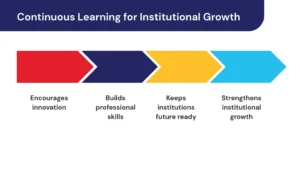
Institutional growth is not achieved through occasional change it is built through a culture of continuous learning.
Professional events encourage institutions to remain curious, reflective, and open to new ideas. They provide opportunities for faculty members, administrators, and institutional leaders to explore developments in areas such as digital education, academic leadership, curriculum innovation, quality enhancement, student-centred learning, and educational technology.
By participating in these discussions, institutions remain better informed about changes affecting higher education while developing the confidence to respond proactively rather than reactively. An institution that regularly engages with international conversations on emerging trends is far less likely to be caught off guard by shifts in student expectations, technology, or workforce demands.
Continuous engagement also demonstrates an institution’s commitment to professional development. Faculty members who regularly participate in academic forums often return with practical knowledge that benefits colleagues, students, and the wider institution. Over time, this creates a ripple effect: one educator’s exposure to a new idea at a conference can influence an entire department’s approach to teaching or assessment.
This culture of ongoing learning also has a reputational dimension. Institutions that are visibly active in professional communities presenting at conferences, contributing to panel discussions, hosting webinars are often perceived as more engaged, more forward-thinking, and more committed to quality than those that operate in isolation.
It’s worth being clear that simply attending a conference or registering for a webinar does not automatically translate into institutional growth. The real value comes from active engagement asking questions, participating in discussions, following up with new contacts, and genuinely reflecting on what was learned.
Institutions that treat professional events as a checkbox exercise, sending representatives without a clear purpose or follow-up plan, often miss the deeper benefits these gatherings can offer. In contrast, institutions that approach conferences and webinars with specific goals whether that’s exploring a particular challenge, seeking potential partners, or staying current on a specific trend tend to extract far more long-term value from their participation.
The International Association of Colleges & Universities (IACU) recognises that meaningful collaboration begins with meaningful conversations. As a global membership association, IACU brings together universities, colleges, vocational institutions, online education providers, and research organisations from different regions to create opportunities for professional engagement and knowledge sharing.
Through conferences, webinars, workshops, leadership forums, and academic discussions, IACU provides platforms where educators and institutional leaders can exchange ideas, discuss emerging trends, and learn from one another’s experiences. These activities are designed not only to share knowledge but also to strengthen professional relationships across the international education community.
The association also encourages members to contribute their own expertise, recognising that every institution regardless of its size or location has valuable experiences that can benefit others. A small regional college may have insights on student retention that prove just as valuable to the wider community as a large research university’s perspective on digital transformation.
For institutions seeking a structured, ongoing pathway into international professional dialogue, participating in an association like IACU offers regular, low-barrier access to exactly the kind of conversations that drive institutional growth without requiring institutions to independently organise international engagement from scratch.
Conferences and webinars are far more than professional development checkboxes they are engines of institutional growth, innovation, and lasting collaboration. The presentations and sessions matter, but the real value lies in the conversations that follow: the questions asked, the relationships formed, and the ideas adapted to fit each institution’s unique context.
Institutions that engage actively and consistently with these professional communities position themselves to learn faster, adapt more confidently, and build the kind of international relationships that support long-term success. In a higher education landscape shaped by rapid change and global interconnection, the willingness to participate, listen, and collaborate may be one of the most valuable strategies an institution can adopt.
Through global platforms such as IACU, colleges, universities, and vocational institutions gain consistent access to the people, ideas, and opportunities that transform isolated challenges into shared learning and shared learning into lasting institutional growth.
1. How do conferences contribute to institutional growth?
They expose educators to new ideas, approaches, and challenges from other institutions, sparking improvements in teaching, leadership, and strategy.
2. Are webinars as valuable as in-person conferences?
Yes. Webinars offer accessible, ongoing opportunities for knowledge-sharing and networking, especially for institutions with limited travel resources.
3. Does attending events alone guarantee institutional benefits?
No. Active participation, follow-up, and reflection are what turn attendance into meaningful institutional growth.
4. How do professional events lead to lasting partnerships?
Conversations started during sessions or networking often evolve into research collaborations, faculty exchanges, or joint projects over time.
5. Can smaller institutions benefit from global professional events?
Yes. Institutions of every size bring valuable expertise and often gain as much as they contribute.
6. What role does IACU play in these professional events?
IACU organizes conferences, webinars, and forums that connect global institutions for knowledge-sharing and long-term collaboration.
This contributor is a recognized member of the IACU global expert network, sharing research-backed pedagogical models and vocational frameworks.